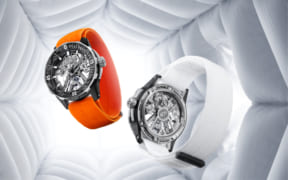

Hosoda, a diving lover (?) from the Chronos Japan editorial team, laments the current poor fortunes of diver's watches, but still sees a bright future for them in the Ulysse Nardin Diver Air. What did he entrust to this ultra-lightweight diver's watch?

Text by Yuto Hosoda (Chronos-Japan)
[Article published on January 16, 2025]
Sadly, the times are tough for divers
Looking at the watches announced at this year's Watches & Wonders Geneva, I had a thought: there weren't many diver's watches! Well, that's only natural. It's a little late to say this as we're nearing the end of 2025, but this year's trends are all about small cases and colored dials.
The quickest way to cut costs for the ever-rising price of gold is to make the case smaller, and in a sense, a small-diameter dress watch is an easy way to counter the huge boom in luxury sports watches. Furthermore, with concerns about the uncertain future of the Chinese market growing to this extent, it would be more prudent to increase the color variations rather than take the gamble of developing a new movement.
Amidst this trend, diver's watches have been left out in the cold. In recent years, luxury and sporty watches have been in demand, but there has never been a demand for high-spec sports watches. Even if they wanted to ride the current trend, diver's watches, which rely on visibility, would be difficult to make extremely small in diameter, and even if they tried to create a subtle neutral color on the dial, the light would be absorbed in the ocean (water), making it impossible to achieve the desired color.

The fact that diver's watches are struggling is clear from the fact that in the Watches & Wonders special feature of the July issue of Chronos Japan, the only diver's watches featured were from Tudor, Montblanc, and Ulysse Nardin. Of course, Chronos Japan, with its limited space, doesn't cover all the new releases announced at Watches & Wonders. However, with the number of participating brands increasing every year and the range of watch prices expanding, it's disappointing that there are so few diver's watches that are worthy of attention.
However, in this year of dive watch barrenness, there is one watch that deserves attention: the Ulysse Nardin Diver Air. In this article, I would like to delve into this unusual dive watch in order to bolster a trend that hasn't seen much excitement in the luxury watch industry (with a few exceptions, such as Blancpain, which also attracted attention due to its smaller diameter).

Automatic (Cal. UN-374). 21 jewels. 21,600 vph. Power reserve approximately 90 hours. Titanium and carbon fiber (diameter 44mm, thickness 14.7mm). Water resistant to 200m. Price: 6,435,000 yen (tax included).
Don't talk about divers without wearing one
Let me make it clear that this is not an impression. I did wear it, but the time was very short (one night), and the limited time I wore it was only for a few hours on the first day, when I was doing desk work to finalize the proofreading. The next day, I had the unexpected event of giving birth to my first child (earlier than expected), so I only wore it lightly, without any environment or measuring stick that would allow me to properly evaluate this watch.
I considered writing an impression-style piece praising the comfortable fit of the extremely light case, but I knew that it would be unethical to recommend a watch worth over 600 million yen to readers in a way that was disguised as a wear review. This introduction is long, but I want to make it clear that this article is merely a summary of my own arbitrary and arbitrary opinions and prejudices about the Diver Air, which I have only touched on briefly (which is why I have categorized this article as a blog).
Digging deeper into the impact of numbers
My first impression when I picked up the Diver Air and actually put it on can be summed up in one word: "light." The total weight of 52g, including the strap, was enough to confuse my preconceived notion that diver's watches are heavy.
The reason why such a light diver's watch was made possible was because the case was made of lightweight materials, carbon and titanium, and even more importantly, the movement's base plate and bridges were made of titanium and lightweighted to the maximum extent possible.

Brass is typically used for the baseplate and bridges of movements because it is soft and easy to work with. However, if a brass movement were hollowed out to the extent required for a Diver Air, it would be difficult to achieve the shock resistance required for a sports watch. This is because the tensile strength of standard brass (C2801) is 325 MPa. Grade 5 titanium (Ti-6Al-4V) is more than twice as strong, at 895 MPa. Incidentally, this figure is roughly twice as strong as that of steel (SS400) or brass, and approximately 1.7 times stronger than that of stainless steel (SUS304) (Reference: Japan Titanium Association).
In addition, because the weight of the head itself is lighter, the impact force generated when the watch is subjected to an impact is also reduced. When talking about wristwatches, the expression "lightness hides seven flaws" is often used, and for sports watches, the element of "lightness" is an irreplaceable advantage.
Let's (forcefully) consider the benefits of lightweight divers as a diving tool.
So why haven't lightweight diver's watches seen the light of day until now? Technically, it's difficult to achieve the required magnetic resistance. For example, ISO 6425, which defines the standards for diver's watches, states that "diver's watches must be magnetically resistant in accordance with standard ISO 764," but also stipulates that "in accordance with standard ISO 764, they must be tested for stoppage and residual effects in a direct current magnetic field of 4800 A/m."
To meet these standards, many diver's watches encase their movements in a soft iron inner case, which naturally increases the weight of the watch and makes it impossible to create a skeletonized watch.
On the other hand, the Diver Air does not comply with ISO 6425, but there is no need to worry about magnetic resistance as the parts around the escapement and regulating mechanism, such as the balance wheel and anchor, are made of silicon, which is a specialty of this material.

The other factor, of course, is the balance with cost. As I mentioned at the beginning, the Diver Air is an ultra-luxury watch priced at over 600 million yen. I certainly wouldn't consider this watch overpriced, considering it features a skeletonized movement crafted from titanium, a difficult-to-cut material, and a lightweight case that's water-resistant to 200 meters. However, there's probably no diver out there who would pay that much for a diving tool.
Even if you buy all the standard diving equipment, such as a BCD, wet/dry suits, and a dive computer, it will cost you at most 100 million yen. If you add in a camera housing for underwater photography and technical diving equipment like a rebreather, which most divers probably won't use, you'll still have plenty of money left over. That's about what 600 million yen is.
Also, the word "lightness," which is such a great benefit to watches, may not be as appealing in the ocean (water) where buoyancy occurs as it is on land. This is because when diving, weights are worn to dive efficiently. Of course, the actual weight worn will vary depending on the diver's weight and skill, the type of tank used, the type and thickness of the suit, and the entry method, but when you're deliberately trying to wear something heavy, whether the watch is heavy or light may be a trivial issue.
However, if you want to determine the best weight for you, keeping your accessories as light as possible will allow for more accurate calculations. Also, the more advanced you become, the lighter the appropriate weight becomes, so a lighter watch will likely be preferred.
The future of ultra-luxury divers depends on Divers Air
After reading this desperate article, you must have realized the futility of evaluating ultra-luxury diver's watches as purely diving tools. However, this is precisely the reason why new diver's watches are not increasing in the luxury watch market.
In other words, it is difficult to find an excuse for the high price of a watch in its role as a tool. Ulysse Nardin, on the other hand, has overcome this problem by creating the value of "ultra-lightweight" in aspects other than diving. Ulysse Nardin is probably the only brand that can create such a convincing ultra-luxury diver's watch without using precious metals such as gold.
I doubt many people will actually wear this watch while diving. One last thing: if you wear a watch while diving, you will need to either wear it on your wrist or leave it in a locker. When using lockers, due to the number of people, multiple people, such as buddies, may have to put their valuables in the same locker.
Some people may not pay much attention to their timepieces and place their watch on top of their smartphone. A diver's watch can minimize damage in such situations and can be worn together with the smartphone in case of emergency, making it the perfect diving companion, even if you plan to only use it on land.