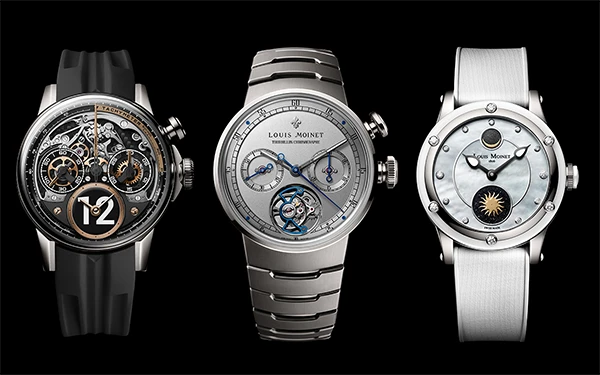

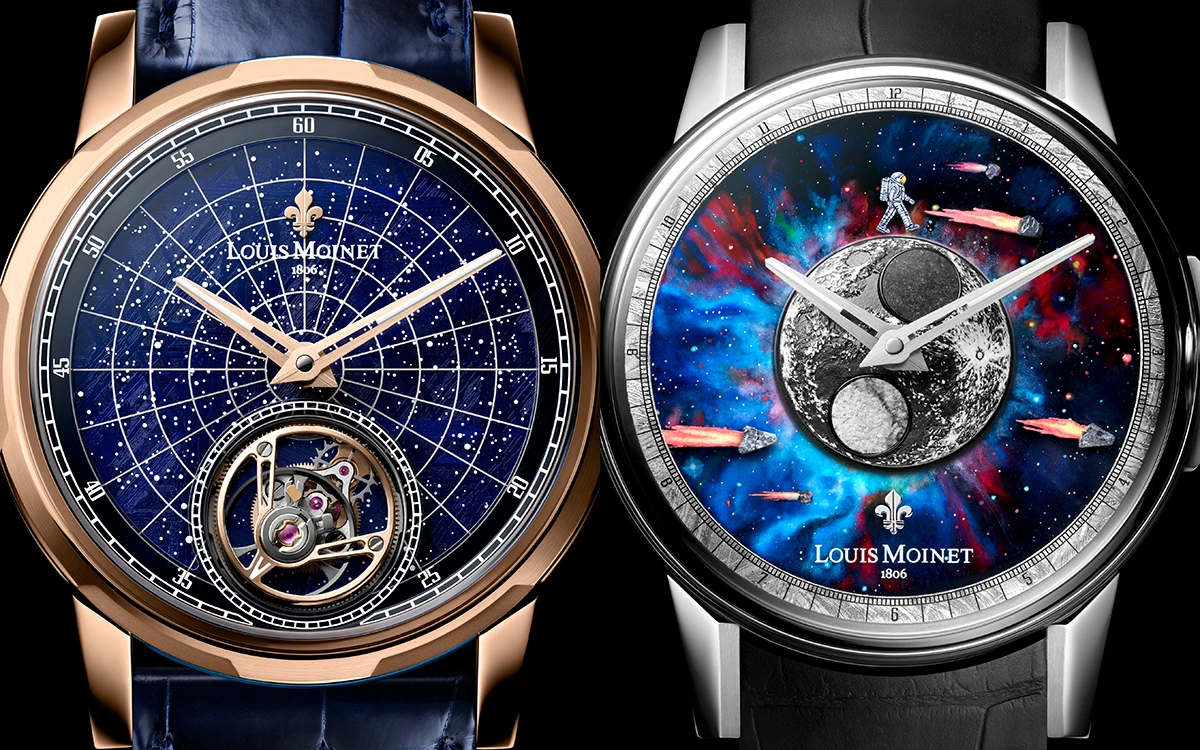
Louis Moinet, founded in 2004 by Jean-Marie Schaller to carry on the legacy of watchmaker Louis Moinet, unveiled two new models from its "Cosmic Art" collection at Geneva Watch Days 2026, featuring dials made from meteorites.
Text by Shinichi Sato
[Article published on January 9, 2026]
"Stellarium"
The "Stellarium" collection, which inherits the romance of astronomical observation that inspired watchmaker Louis Monet to invent the world's first chronograph, the "Contour de Tiers," in 1816, has been unveiled. This new piece is part of the "Cosmic Art" collection, which uses materials of extraterrestrial origin, and is limited to 12 pieces worldwide. The dial base is made from the Muonionalusta meteorite, discovered in northern Scandinavia.
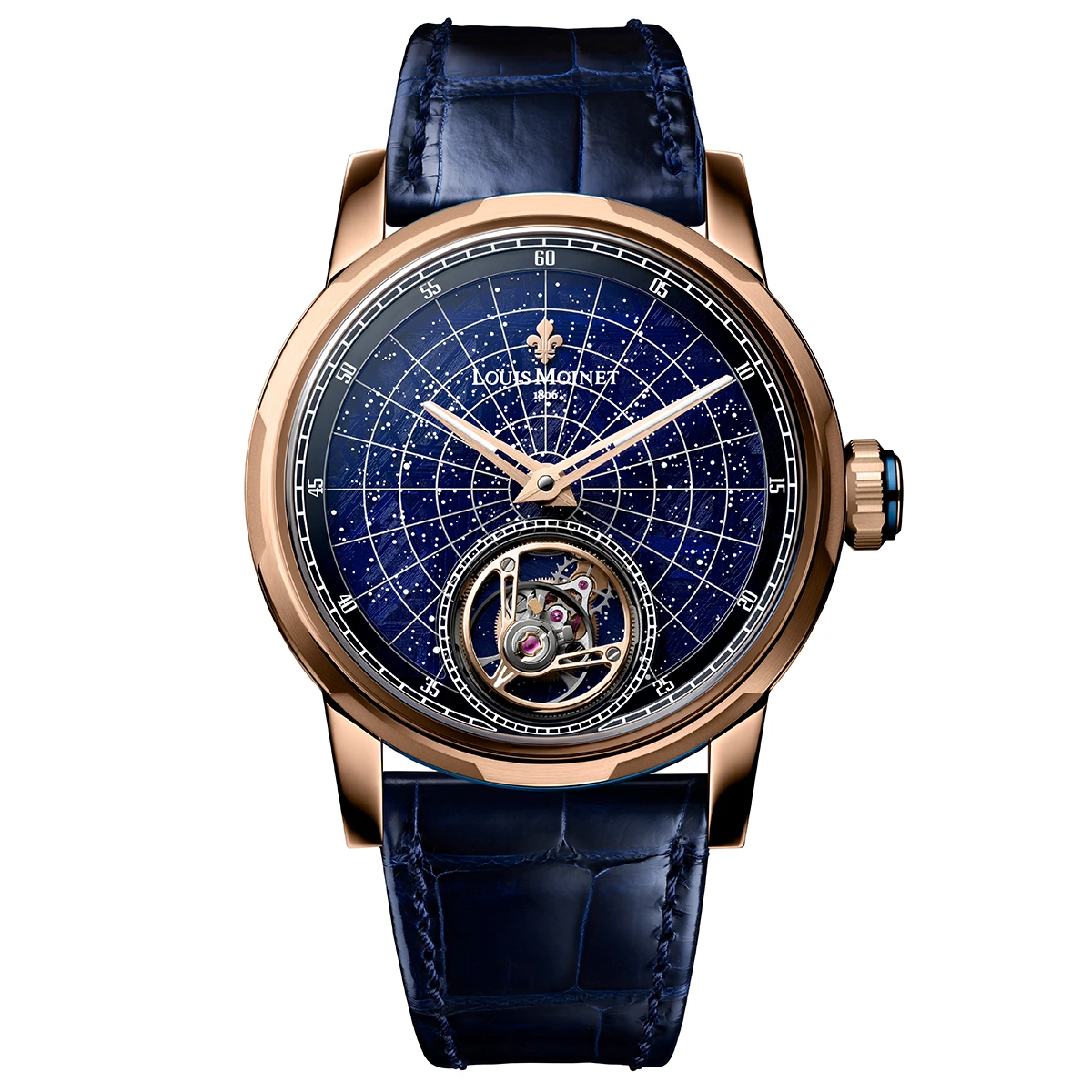
Manual winding (Cal. LM180). 26 jewels. 28,800 vibrations/hour. Power reserve approximately 96 hours. 18K rose gold case (42.5mm diameter, 15.85mm thickness). 3 ATM water resistance. Limited edition of 12 pieces worldwide. Price TBD.
The Muonionalusta meteorite, discovered in northern Scandinavia, is an iron meteorite formed approximately 45 billion years ago during the early stages of the solar system's formation. It is characterized by a geometric pattern called the "Widmanstätten structure," which occurs during the long cooling process in space. In this piece, the meteorite is dyed deep blue, creating a finish that makes the crystalline pattern emerge from the depths of the blue. On top of this, a sapphire crystal disc depicting longitude and latitude lines and stars is superimposed, creating a design reminiscent of a star chart. The design, with stars floating against a richly expressive deep blue background, expresses the romance of astronomical observation.
The case back features a planetarium depicting the alignment of the solar system. The celestial configuration reproduced is that of March 21, 2013. This date marks the day when the brand's founder, Jean-Marie Schaller, announced at the Neuchâtel Observatory in 1816 that the "Contour de Tiers," an astronomical chronograph manufactured by watchmaker Louis Moinet, was the world's first chronograph. Furthermore, it is possible to customize the celestial configuration to match a special date such as a birthday or anniversary, according to the owner's wishes, allowing them to entrust the history of watchmaking, or even a milestone in their own life, to the scenery of the solar system.
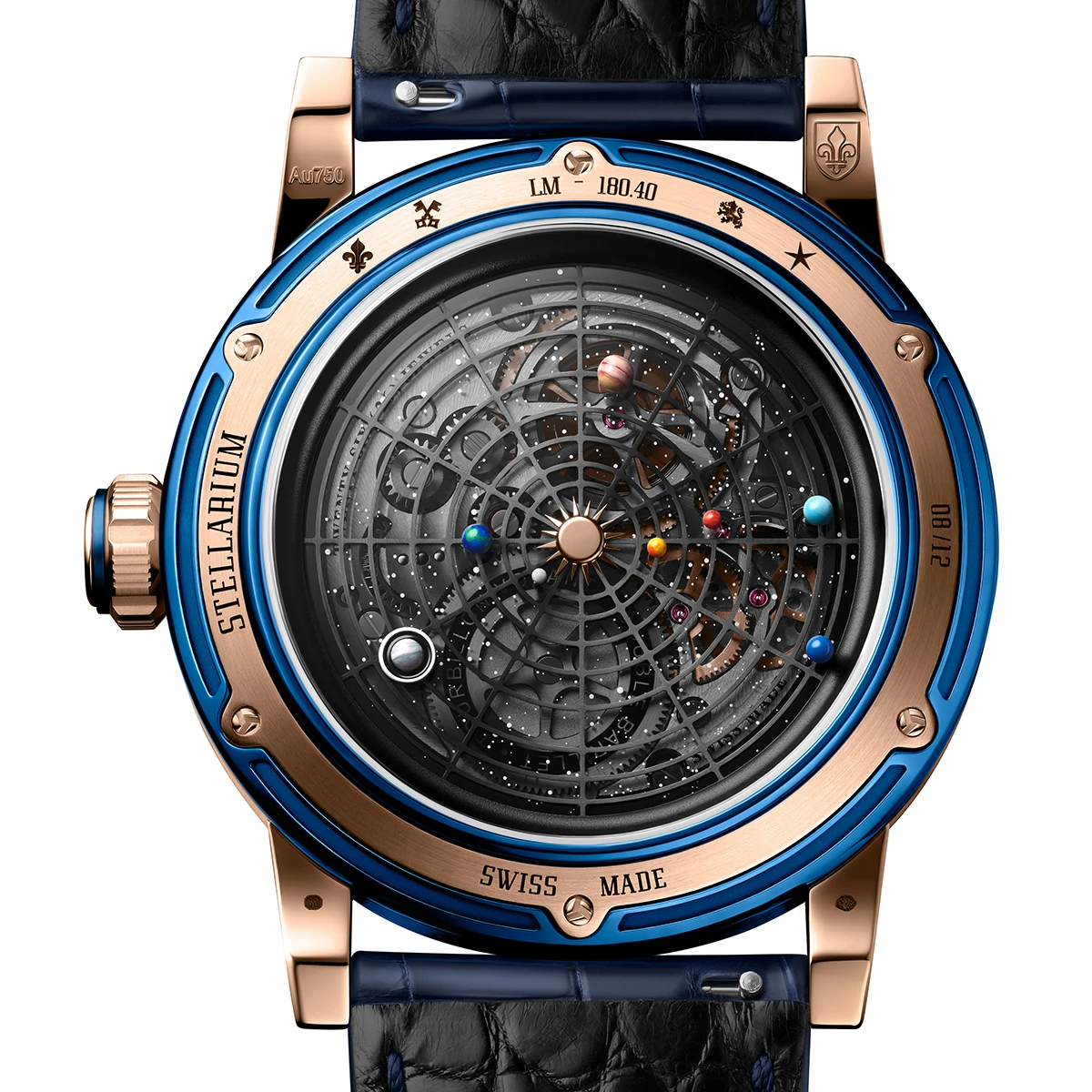
The new case features an 18K rose gold exterior with a combination of polished and satin finishes. The sides are openworked, revealing a Grade 5 titanium inner case with a blue DLC coating.
The watch houses the Cal.LM180, a hand-wound movement exclusive to Louis Moinet. A flying tourbillon is positioned at 6 o'clock, and the rotation of the carriage also functions as a seconds indicator. It features a twin barrel system with a "volté face" that inverts the orientation of one of the mainspring barrels, supplying the energy necessary to drive the tourbillon while ensuring a power reserve of approximately 96 hours.
"Moon Meteor"
Louis Monet has unveiled "Moon Meteor," a new addition to his "Cosmic Art" collection, which uses materials of cosmic origin. The watch expresses the romance of space through six types of meteorites and miniature paintings. The dial features a nebula depicted with luminous paint and is adorned with four real meteorites. This piece is limited to just 12 pieces worldwide.
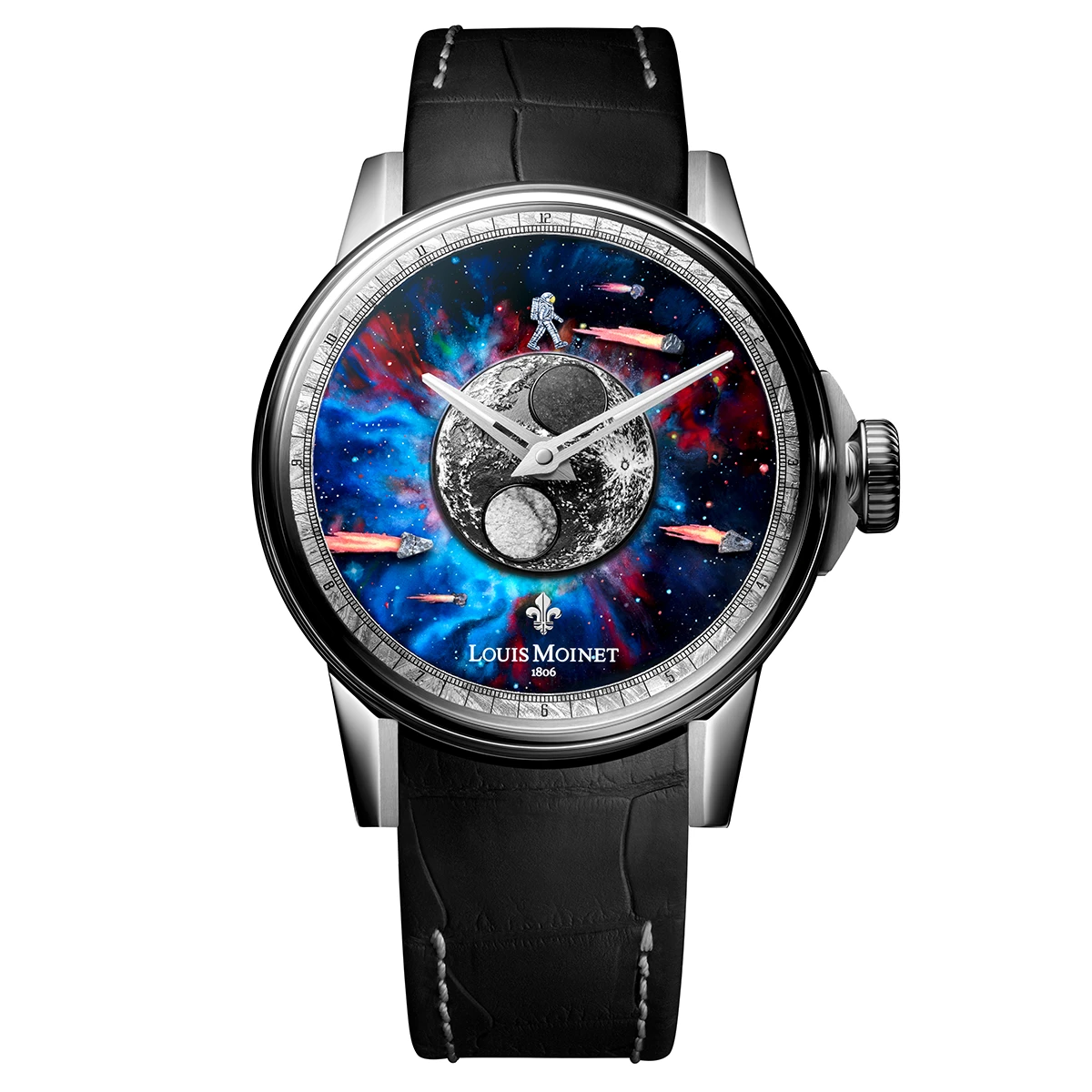
Automatic movement (Cal. LM113). 29 jewels. 28,800 vibrations/hour. Power reserve approximately 48 hours. Titanium case (40.7mm diameter, 17.92mm thickness). 3 ATM water resistance. Limited edition of 12 pieces worldwide. Price TBD.
At the 2 o'clock position is the "Dzibir-Wins-One meteorite," a carbonaceous chondrite meteorite discovered in Morocco. Believed to originate from a mysterious asteroid, it is one of the scientifically important meteorites, containing amino acid molecules that may be linked to the existence of life. At the 4 o'clock position is "Sahara 97093," an EH3 type enstatite meteorite discovered in the Sahara Desert.
This meteorite is unique in that it originated from a supernova explosion that occurred long before the solar system was formed. At the 8 o'clock position is the "Martian meteorite NWA 13925," which is a part of Mars that was ejected into space by a celestial collision and became a meteorite. Its rarity is extremely high, making it one of the highlights of this piece. The flange surrounding these is made of "Muonionalusta," an iron meteorite formed approximately 45 billion years ago. Its notable feature is the Widmanstätten structure that appears on its surface, which was created by cooling over a long period of time in space.
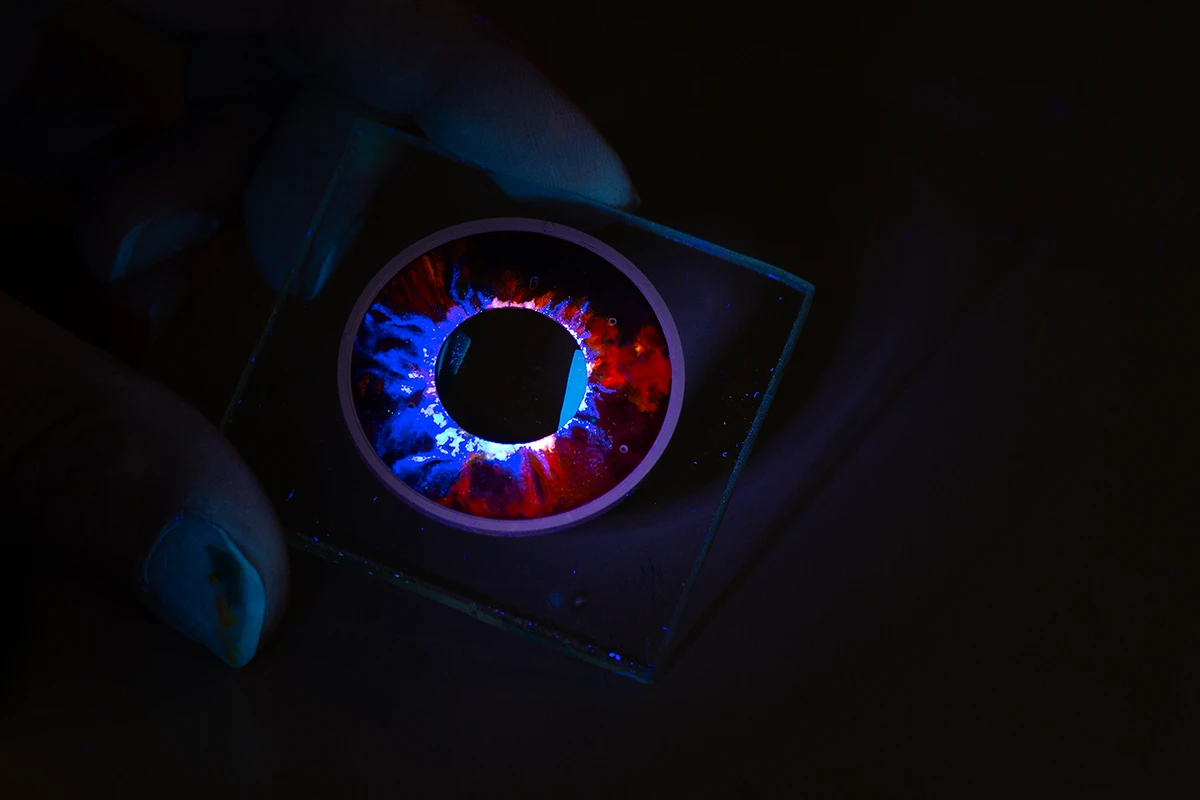
At the center of the dial is a large, slightly domed moon disc. The disc, which depicts craters and reliefs through engraving and hand-painting, also incorporates two types of lunar meteorites. The part representing the full moon is inlaid with the grayish-white lunar meteorite "Ghadamis 005." On the other hand, the new moon side uses the deep black lunar meteorite "Dhofar 457," discovered in 2001 in the Dhofar Desert of Oman. The way the full moon and new moon are depicted using two different types of real lunar meteorites evokes a sense of wonder and romance about the universe.
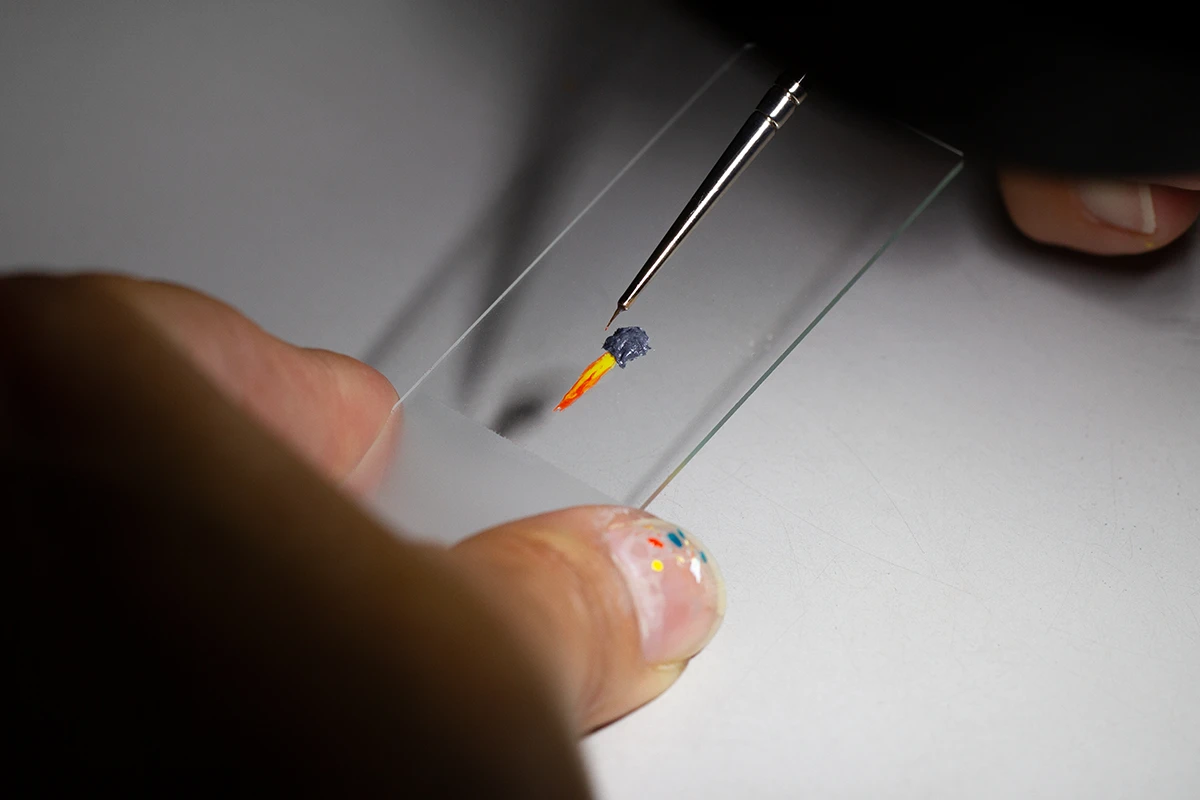
This moon phase disc is powered by the automatic movement Cal.LM113. This movement, developed in collaboration with Concepte, is exclusive to Louis Moinet and boasts a moon phase display error of only one day in 122 years.