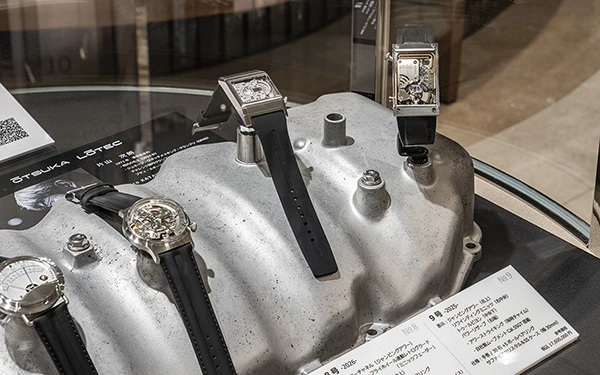

On August 25, 2026, a robbery occurred in Nakano Broadway. Two men broke into a secondhand watch shop and stole four luxury watches. The total value of the stolen items was approximately 200 million yen. The suspects were arrested shortly after the incident, but three of the stolen watches have not been recovered. Why did such an incident occur in broad daylight? Yasuhito Shibuya, who studied criminal policy at Waseda University's Faculty of Law and is now active as a journalist, sheds light on the "background" of the incident.

Photographs & Text by Yasuhito Shibuya
[Article published on January 11, 2026]
Luxury watch robbery in Nakano
On August 25, 2026, just before noon, a robbery occurred at a secondhand watch shop in Nakano Broadway, a "mecca for subculture," where four luxury watches were stolen. Two days later, on the evening of August 27, two men of Chilean nationality, who were staying at a private lodging facility in Osaka, were arrested on suspicion of theft in connection with the robbery. Although one of the four stolen watches was recovered, as of the morning of August 29, when this article is being written, three of them are still missing.
Media coverage, particularly on television news, focused on the fact that "just four bottles were worth 200 million yen." However, no convincing articles that properly explain the background of this case can be found. Therefore, at the request of the "webChronos" editorial department, I studied in Professor Masamitsu Ishikawa's (Professor Emeritus of Waseda University and the first director of the Institute for Social Safety Policy) criminal policy seminar at the Faculty of Law, Waseda University, more than 40 years ago, and have previously contributed analyses of the "Tokematch" case to this publication.https://www.webchronos.net/features/152984/As a journalist who covered this case, I will briefly explain the background of this incident, which the media has not pointed out.

"Crime tourism" by South American theft rings
As mentioned above, the two men apprehended at a short-term rental property in Osaka and arrested as suspects in the Nakano Broadway clock robbery case are Chilean nationals Jeremy Paolo Piña Guzman (23) and Boris Alexis Manzano Quesada (33).
When I heard the news about the incident, I immediately predicted that the perpetrators would be caught quickly. This was because, although the crime was carried out efficiently in just 10 minutes, the perpetrators' movements were recorded on security cameras in various locations near the crime scene, and their actions after the crime were extremely sloppy, such as one of the perpetrators using an electric scooter to escape. To use an electric scooter, one must create an account using a smartphone app. The registration information from this app is immediately provided to the police. Creating an account on the app probably also requires official identification. While there is a possibility that the identification was forged, the hurdle to doing so is quite high. It was later discovered that the suspects had created accounts using their real names and passports. In recent years, many overseas accommodations that can be easily booked online require guests to authenticate by taking a picture of their passport with a camera. The private lodging facility in Osaka was probably also booked using real names and passports. It was only natural that they would be arrested.
They arrived at Tokyo's Haneda Airport on August 21, four days before the incident, and claimed to be staying in Asakusa for short-term sightseeing from Sydney, Australia, before checking into a private lodging facility. Two days before the crime, on August 23, the two visited Nakano to scout out a store, and security camera footage from the store showed them searching through display cases without concealing their faces, repeatedly pointing to the display case containing the watches they would later steal. They also apparently conducted a simulation of the crime by renting an electric scooter online in the vicinity and returning it five minutes later. After the crime, they immediately fled to Osaka by Shinkansen, presumably intending to depart from Kansai International Airport afterward. Professionals should have departed in the short time before the airport could be alerted, but instead, they were still at the private lodging facility. This behavior was also sloppy.

article:https://www.webchronos.net/features/107054/
The recent "Nakano Broadway luxury watch robbery" was a planned crime committed by a South American theft ring, posing as tourists to steal and rob, in other words, a case of "crime tourism."
While not yet widely recognized in Japan, "tourism crime" (criminal tourism) committed by South American theft rings, particularly those with Chilean nationality, has become a major problem in the US and EU since around 2016. The FBI has even organized a dedicated team to combat and prevent such crimes. Why Chilean nationality? Because Chile is the only South American country to have adopted ESTA (Electronic System for Travel Authorization). ESTA is a system that allows citizens of 40 countries to travel visa-free for 90 days simply by applying and obtaining it online. Chilean theft rings exploit this system, posing as tourists and committing thefts and robberies worldwide, targeting luxury watches, jewelry, designer bags, and cash. Vanity Fair, an American media outlet that primarily covers celebrity topics, reported on the reality of these criminals in an article dated February 24, 2022, titled "Thieves in the Night: A Vast Burglary Ring From Chile Has Been Targeting Wealthy US Households" (Reference:https://www.vanityfair.com/news/2022/02/a-vast-burglary-ring-from-chile-has-been-targeting-wealthy-us-households?srsltid=AfmBOopfBoBfFMT5I7mtpsLZWYCPnGC6XA4_ms3N44RsrlKDE-qP195V).
Their methods are very similar to those of the "Lanzas Internacionales," a Chilean-based international theft network featured in overseas media articles. Their attire—all black, long-sleeved shirts and long pants—and their use of short-term accommodations as hideouts, perfectly mirror the basic style and behavioral patterns of these international theft rings. They could be described as a Chilean version of "Tokuryu." The two suspects in this case may be low-level "underground workers" within this network. This is because their actions, such as committing the crime in broad daylight in a public space with numerous surveillance cameras and using genuine passports instead of forgeries, are full of vulnerabilities and appear extremely amateurish.
Furthermore, it's clear that this crime wasn't committed by just the two of them, but involved other accomplices. Only one of the four stolen luxury watches has been recovered so far, and it's suspected that the other has fallen into the hands of another accomplice, also disguised as a tourist, arranged by the Chilean version of "Tokuryu." One of the suspects reportedly said he intended to cash in the watches and escape, but cashing them in would be extremely difficult in Japan, where serial numbers are recorded and tracked within the industry. If he intended to cash them in in Japan, it seems like a very amateurish move. If the perpetrators transported the watches themselves, there would be a risk of being discovered during airport inspections. Therefore, it's highly likely that they had friends or family with no criminal record travel as "tourists" and have them bring the stolen goods back. It's unclear who they handed the three watches to, but they have probably already been handed over to other members of the theft ring and taken out of the country. In the case of an organized crime by the Chilean version of Tokuryu, the courier is likely not a friend or family member, but a complete stranger. Once taken out of the country, tracking and recovering them is almost impossible.
Another contributing factor: the "watch investment and watch wealth accumulation boom."
Now, regarding this incident, as someone who has been covering luxury watches for over 30 years, there is something I would like to explain. That is the "watch investment and watch wealth accumulation boom" that has been created over the past decade or so, and accelerated by the COVID-2 pandemic, by the soaring prices of luxury watches in the secondary market.
The main players in this boom are not watch enthusiasts. They are people who are taking advantage of the premium prices placed on watches that are difficult to obtain due to limited production numbers, and are trying to profit from reselling them. They are also people who are using these watches, like gold bullion, to accumulate wealth, especially to hide their assets. While the former group includes many ordinary office workers, it is suspected that the latter group includes companies and criminal organizations such as yakuza that are engaging in activities that are borderline illegal and antisocial, all in an attempt to evade taxes and hide their assets.
The reason why the incident took place in Nakano Broadway, a "mecca of subculture," rather than Ginza, is influenced by these underlying circumstances. Many of the shops in Nakano Broadway sell items that are far removed from luxury goods. For example, in the basement there is a 100-yen shop and stores where you can buy meat and fish cheaper than usual. Used manga-related items, gachapon (capsule toys), and everyday necessities are not expensive at all.

Within Nakano Broadway, secondhand watch shops are an exception. On weekends, many ordinary people enter these shops to choose and purchase watches. However, if you walk through Nakano Broadway on a weekday afternoon, you'll notice that the clientele in the secondhand watch shop area, mainly on the second floor, is completely different. You'll see people who make you wonder, "Why are they here in Nakano?" as they examine "premium-priced luxury watches" that I would absolutely never want to buy.
Investing in or accumulating wealth through luxury watches is a matter of personal freedom and is not inherently illegal. However, depending on the purpose and methods used, it can become "very close to illegal." Furthermore, there are many scams involving super-counterfeit watches, sometimes called "N-grade" replicas. Moreover, the value and price of second-hand luxury watches are constantly fluctuating. Internationally, the "luxury watch value bubble" that began in the 2010s and accelerated during the COVID-19 pandemic in 2020 burst in the spring of 2022. Currently, the secondary market prices of luxury watches, with the exception of special models from special brands, have returned to pre-COVID-19 levels.
Sixty years have passed since its completion in 1966. In a corner of Nakano Broadway, a "mecca of subculture," why are watches worth approximately 200 million yen in market value being traded for just four pieces? Why are they fetching such prices even though they are secondhand? Anyone who, upon learning of this incident, even briefly thought, "I could make money with luxury watches too," should definitely consider this.
Having spent over 30 years covering the watchmaking process, including visiting the workshops of most watch brands in Switzerland and Japan, I understand the value of these watches. However, I cannot comprehend the exorbitant resale prices, and I find it very unfortunate that people who are not watch enthusiasts treat watches simply as "investment items," with none of these transaction prices going to the watchmakers.
Author Profile

Shibuya Yasuhito
As an editor of a product information magazine, he began covering Geneva and Basel in 1995. He has been busy as both an editor and writer, and before he knew it, 2019 was his 25th year. He is currently planning, covering, editing, and writing about not only smartwatches, but also all kinds of things and events other than watches.