
Casio's "Oceanus" sporty line, "Cacharo," has introduced a new model, the "OCW-P3000." This model combines a two-tone ceramic bezel with a newly developed "Time Zone Navigator," making it a world timer that allows you to intuitively grasp the time in various cities around the world. This time, we will focus on the green model, but also use the blue and black models. We will examine its exterior, fit, and functionality, as well as the unique charm of this model, which retains the analog operation of turning the bezel despite being a solar-powered radio-controlled watch.
Text & Photographs by Tsubasa Nojima
[Article published on January 8, 2026]
Casio Oceanus "Cacharo" introduces a new world timer model.
Oceanus is a luxury watch brand developed by Casio. Based on the concept of "Elegance, Technology," the brand combines high-quality titanium-based exteriors with Casio's unique advanced technologies, such as solar charging, standard radio wave reception, and smartphone linking.
Among the Oceanus series, the "Cacharo" line, named after the sperm whale, occupies a sporty position. Since its inception in 2008, it has developed watches with superior functionality, keeping marine sports in mind. Now, the "OCW-P3000" has been added to the Cacharo line, focusing on world time functionality. It can be said that this is an ambitious creation that expands its target audience from the traditional marine sports-centered direction to business people who travel the world.
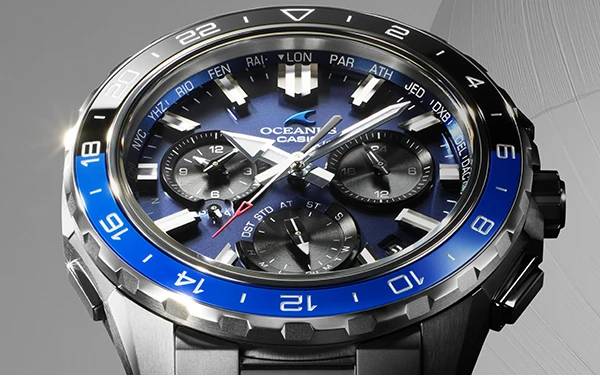
The most distinctive feature of this model is the newly developed "Time Zone Navigator," which utilizes a rotating bezel. By combining city codes placed around the outer edge of the dial with a 24-hour rotating bezel, it allows you to see the approximate time in 26 cities around the world at a glance.
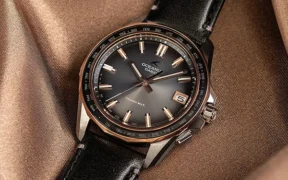
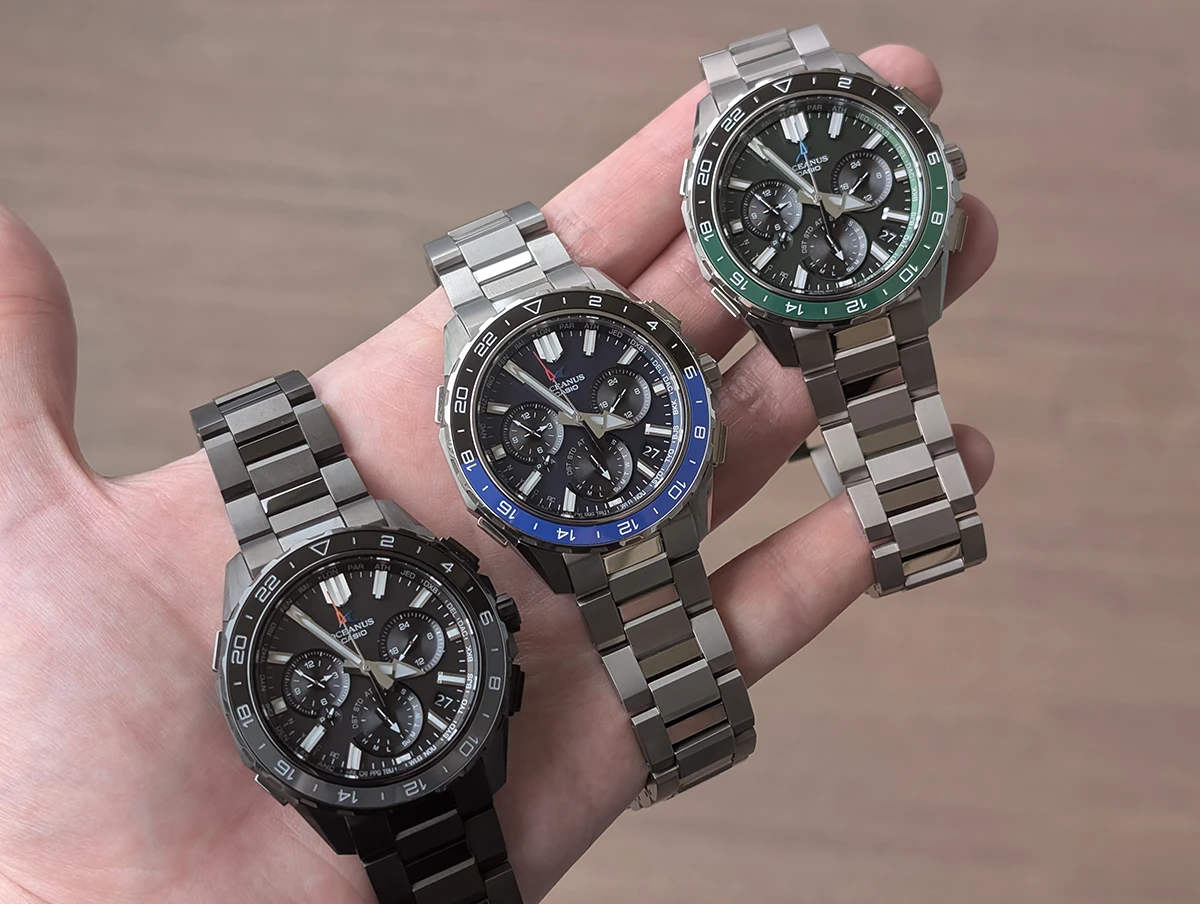
The watch comes in three color variations: blue, green, and black. This time, I'd like to focus my impressions on the "OCW-P3000-3AJF" with a green dial.
High-quality dial thanks to light-shielding and dispersion-type solar panel
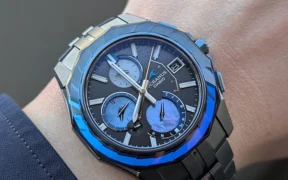
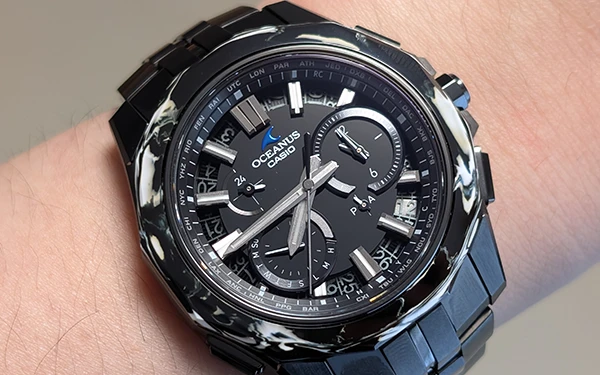
The first thing that catches the eye is the compact dial with three sub-dials on the side. It incorporates a lot of information, such as dual time, day of the week, and various mode displays, but each is clearly separated, so it is not as difficult to read as it might look.
One of the technologies that makes this possible is the "light-shielding dispersion solar panel." In typical solar watches, the dial needs to have a certain degree of transparency in order to secure the light necessary for power generation. To alleviate this constraint, this model employs a structure that receives light mainly in the main dial area, making it possible to use opaque materials with good color rendering for the sub-dials, thus ensuring freedom to enhance texture and visibility.
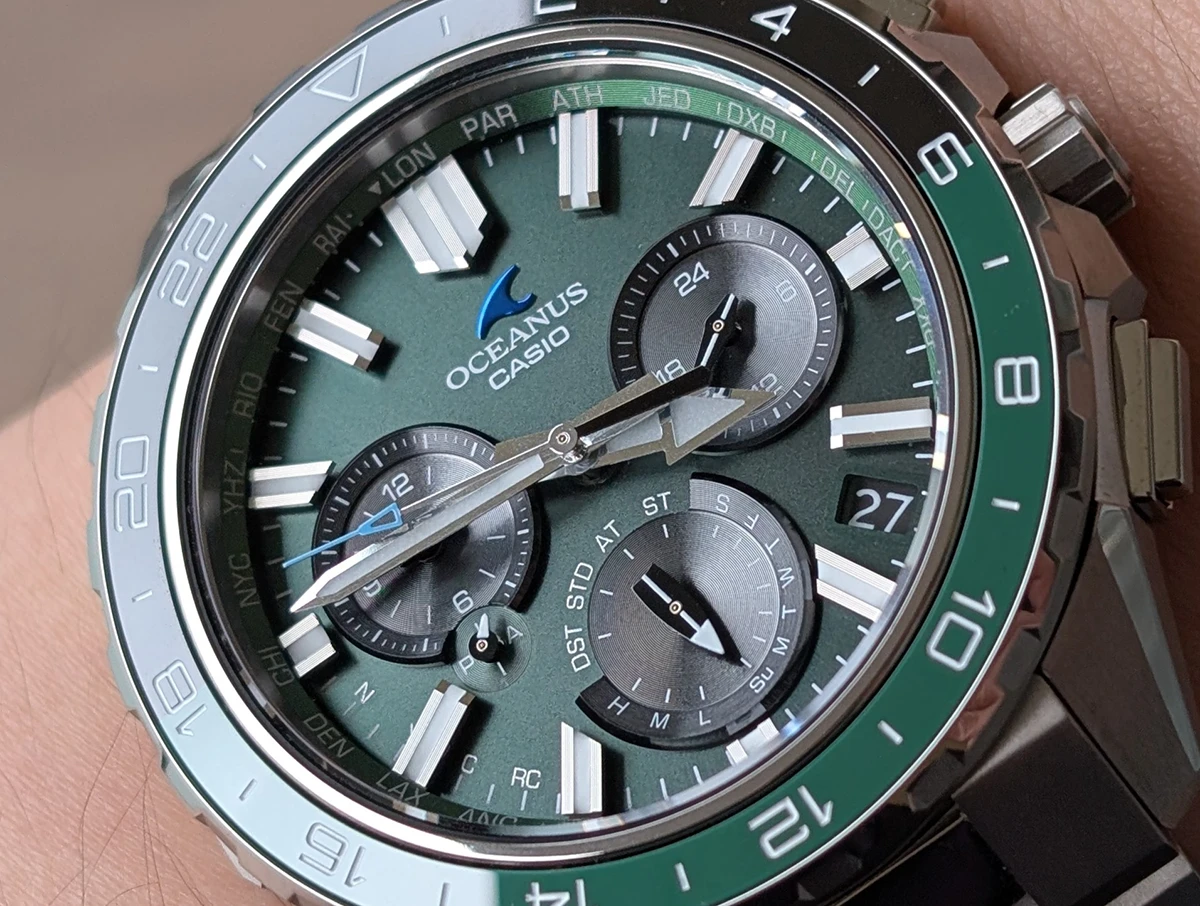
The main dial features a vapor deposition treatment, giving it a metallic texture unlike typical solar watches. The three-dimensional indices and thick hour and minute hands also contribute to its presence, ensuring good legibility despite its multi-functional design. The second hand, with its red tip, serves as both a design accent and plays an important role in operating the time zone navigator, which will be discussed later.
The outer edge of the dial features city codes for major cities around the world. Surrounding this is a bidirectional rotating 24-hour bezel. The bezel insert uses two-tone ceramic, with different colors for day and night. What's noteworthy is the boundary between the two colors. Despite the combination of different colors, the seam is almost indistinguishable, making it look as if it were a single ring painted in two colors. The boundary crosses the numbers 6 and 18, but there is no misalignment in its outline.
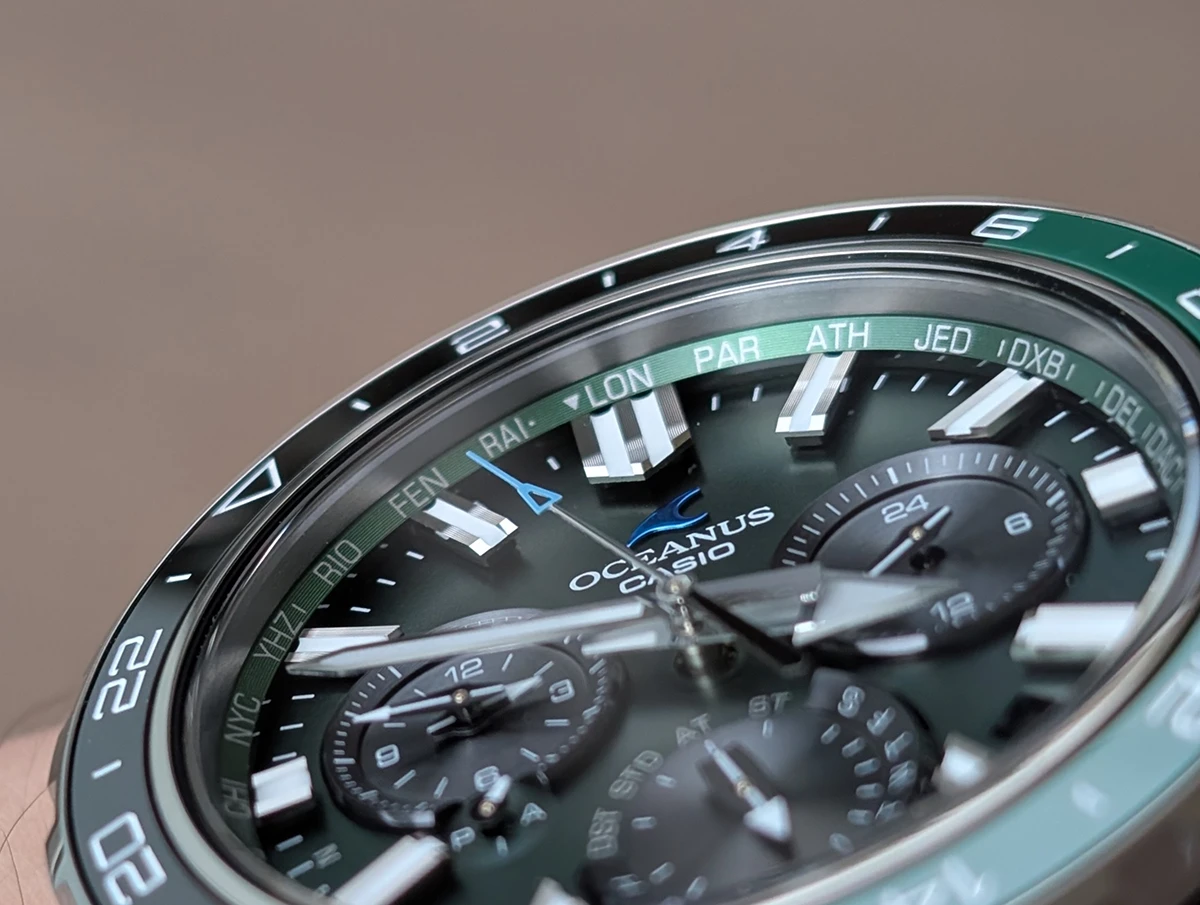
The bezel's outer frame is made of titanium. The sides have knurling for easy gripping. When you actually turn it, the operation feels light and smooth, but it doesn't feel flimsy or prone to accidental movement. According to the official explanation, the developers went through many prototypes during development to achieve a turning feel that is neither too stiff nor too loose.
Although the bezel has a click mechanism, the number of clicks does not correspond one-to-one with the 24-hour scale. However, since this function is not intended for reading the time in each city down to the minute, this is not a practical problem.
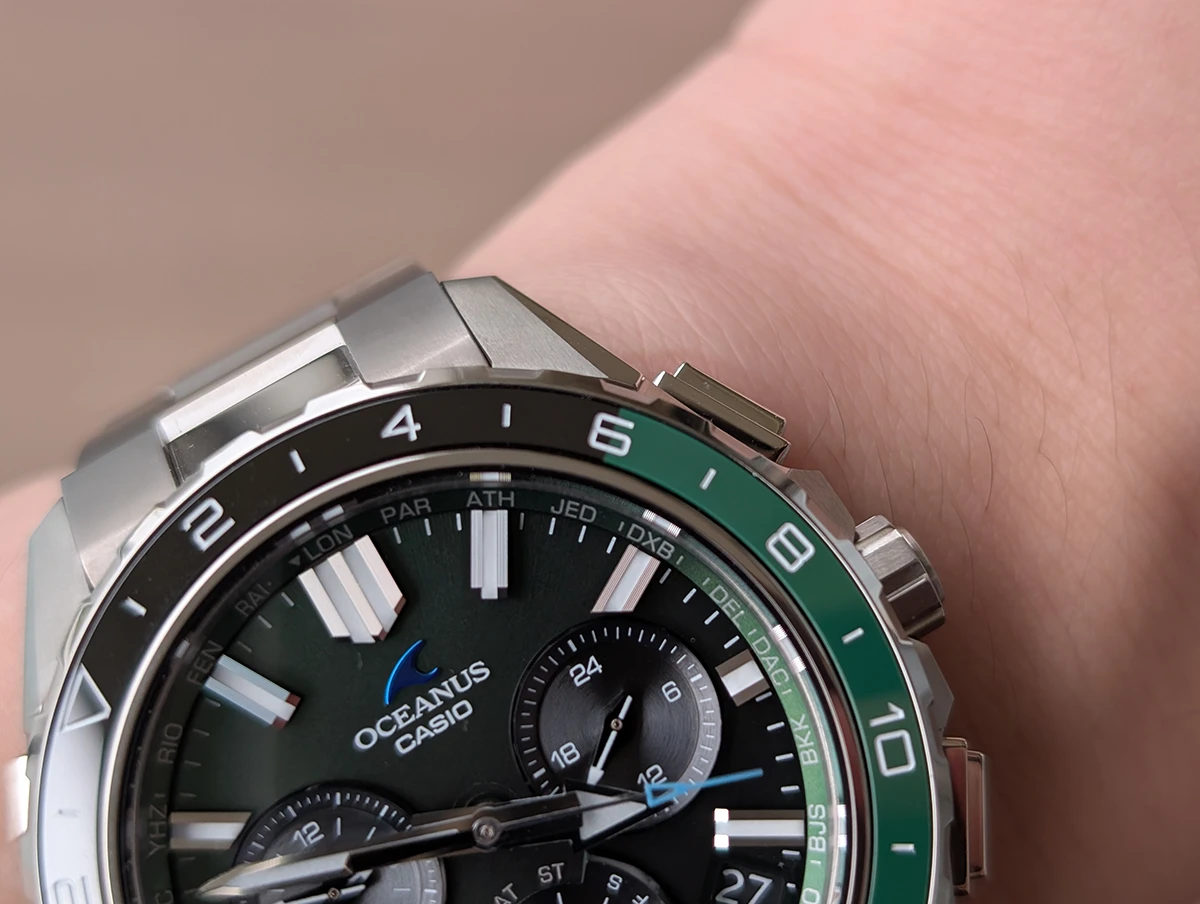
The titanium exterior boasts a strikingly sharp design.
The case and bracelet are made of titanium. The case size is 42.9mm in diameter and 11.7mm thick. Although it looks a bit large in the photos, it is surprisingly thin in person, making it a manageable size for a sports watch.
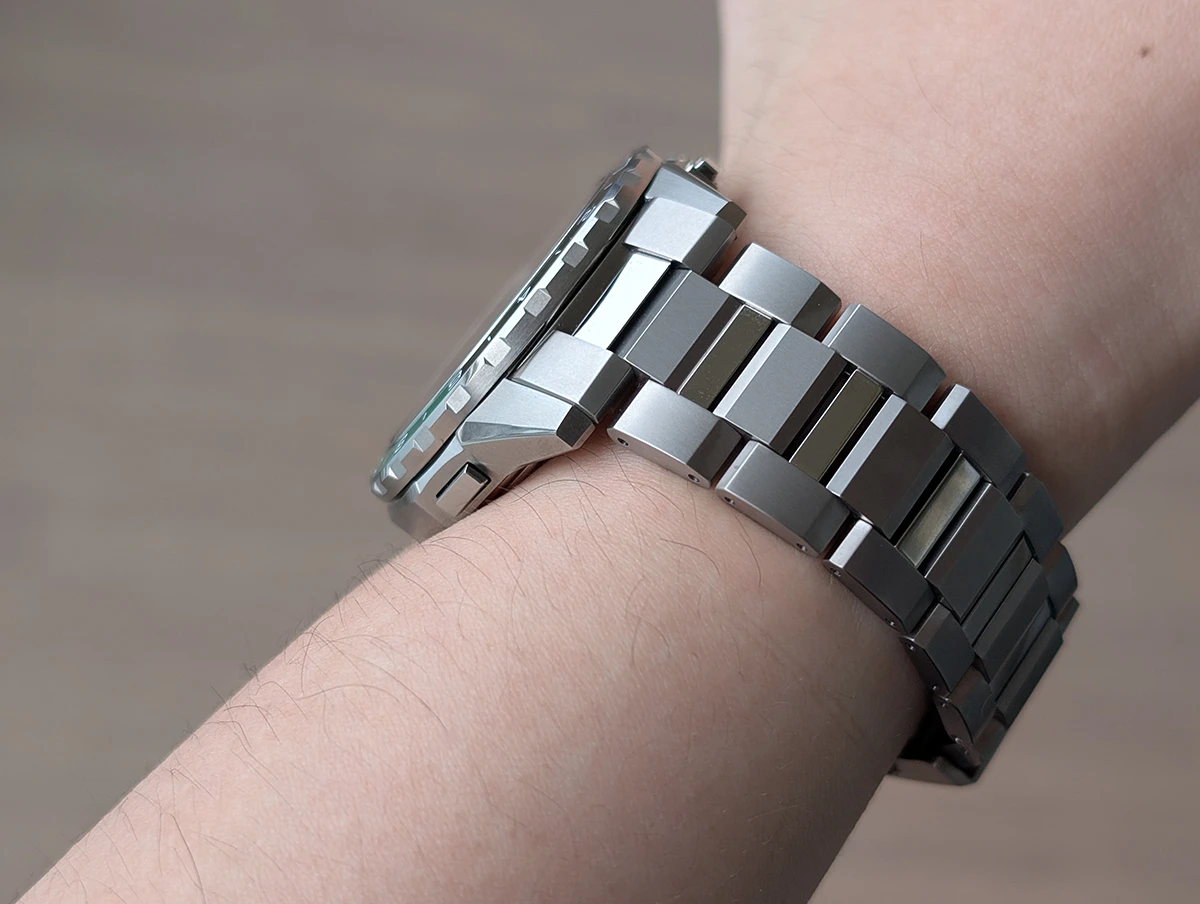
The exterior features a combination of mirror-polished and hairline finishes achieved through Zaratsu polishing, emphasizing the intricate case design. The overall impression is sporty, with features such as the case sides equipped with a crown guard and sharply defined lugs. On the other hand, the push buttons and crown are designed not to protrude significantly from the case, minimizing the risk of catching on a shirt cuff.
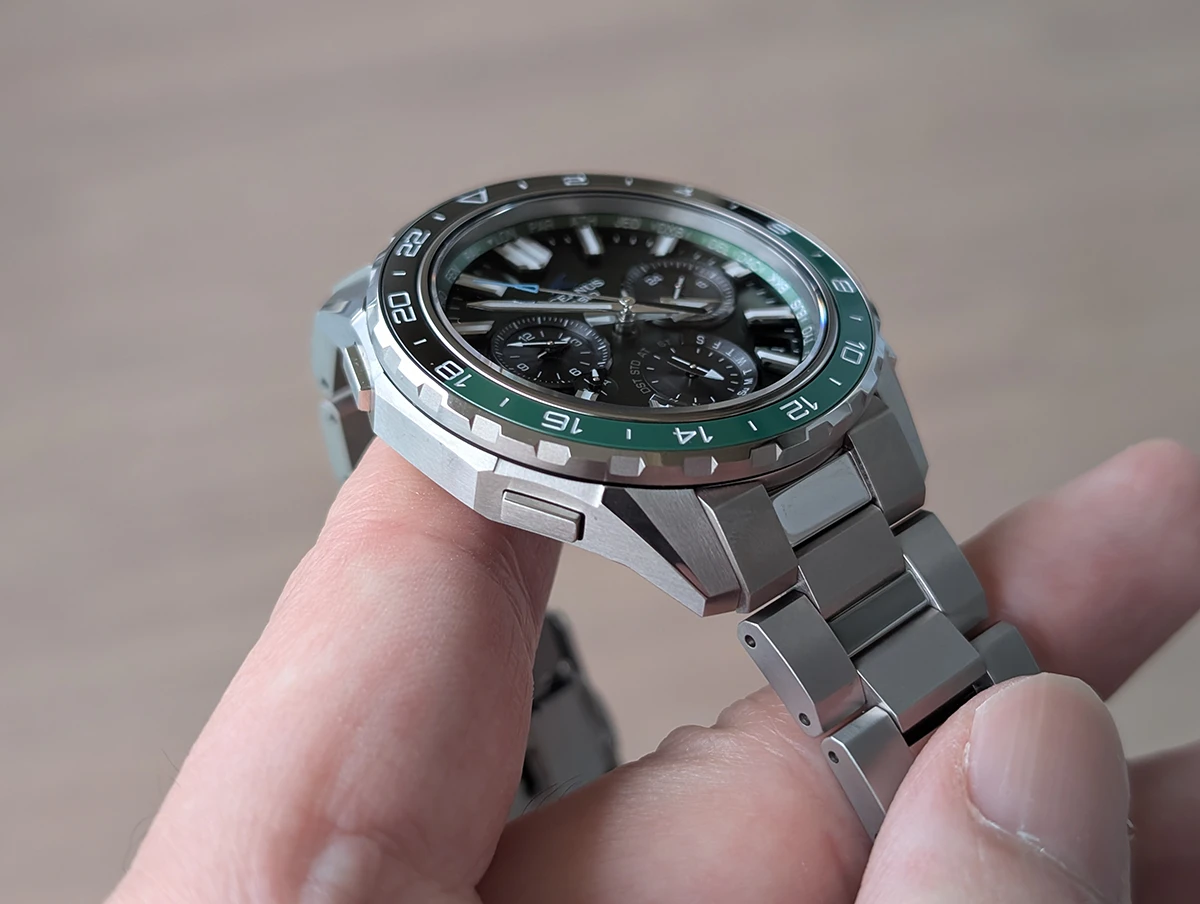
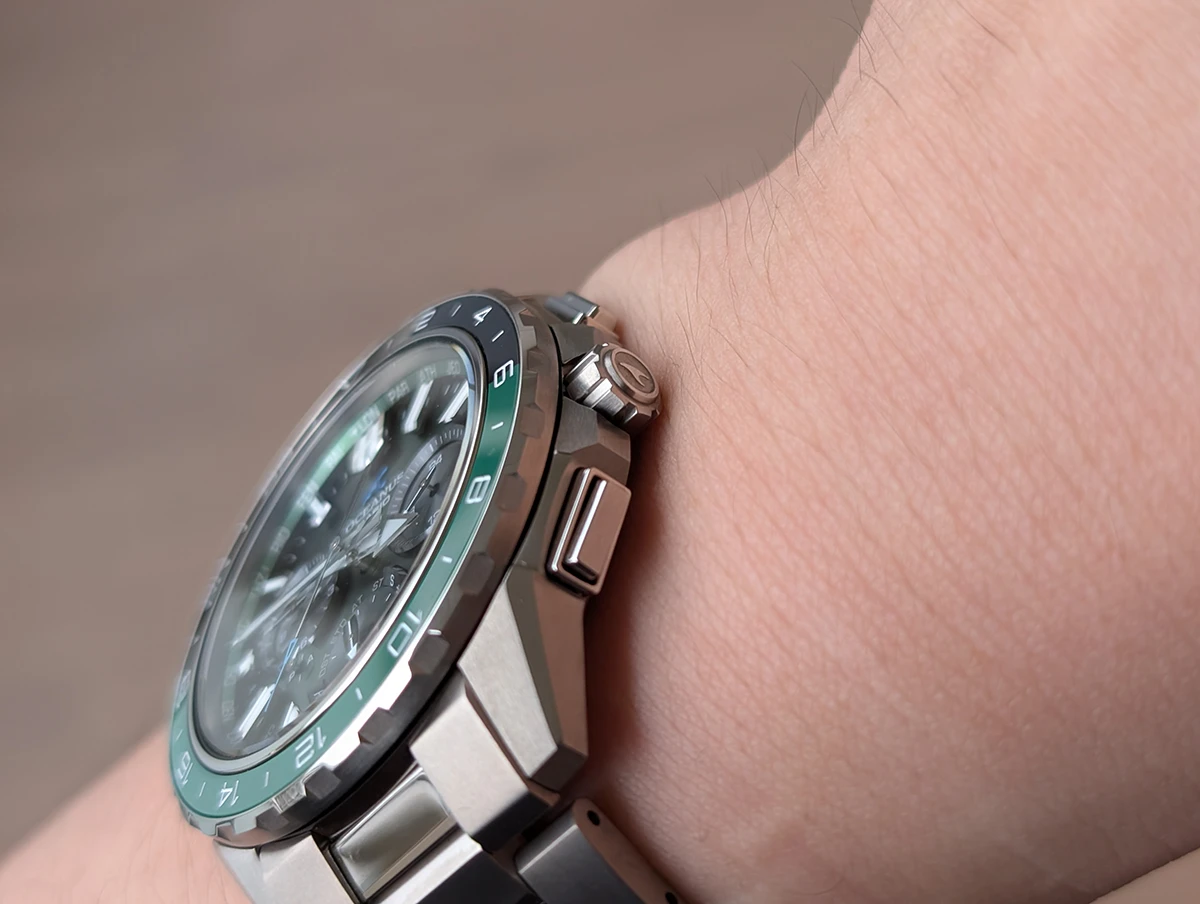
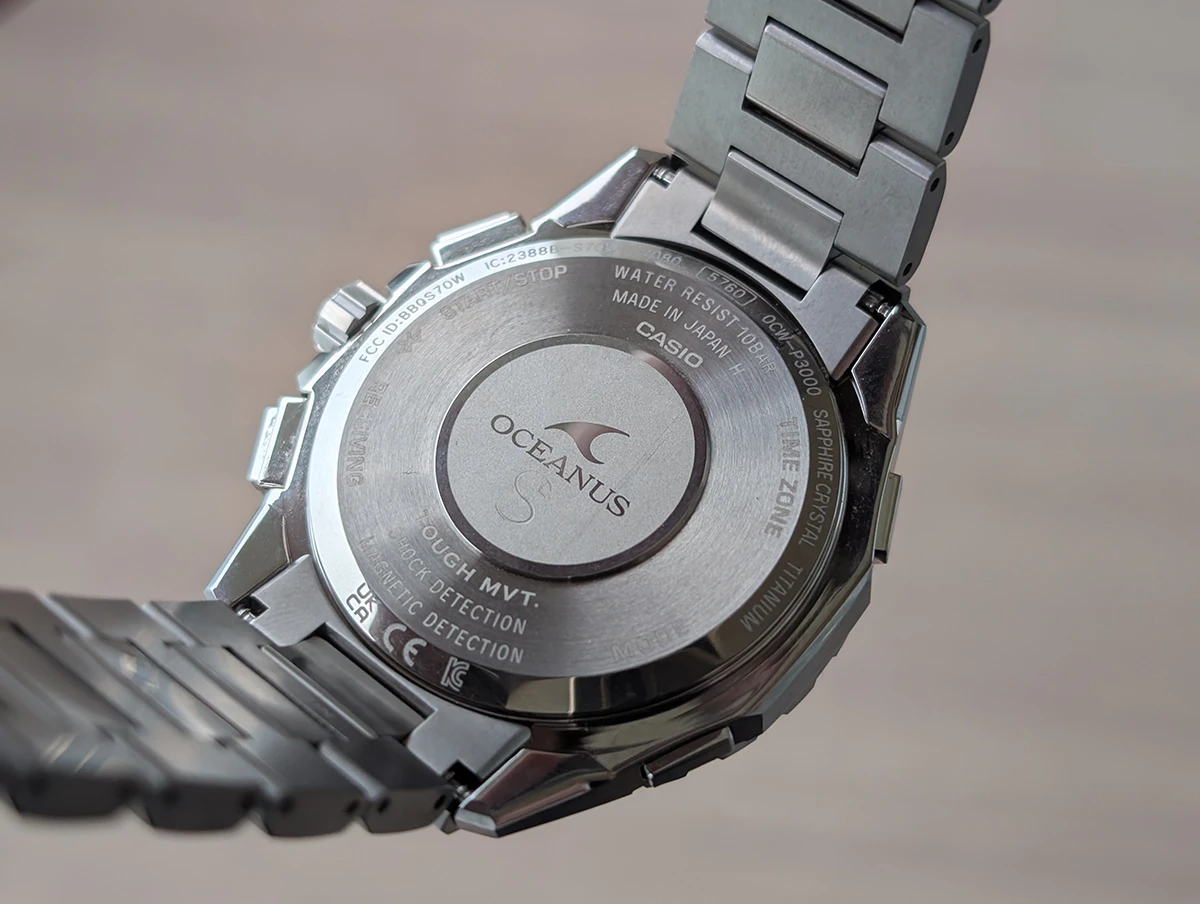
The green and blue models feature a titanium carbide treatment to enhance surface hardness, while the black model uses DLC coating. It's nice that scratch resistance has been considered for a watch that will be worn every day.
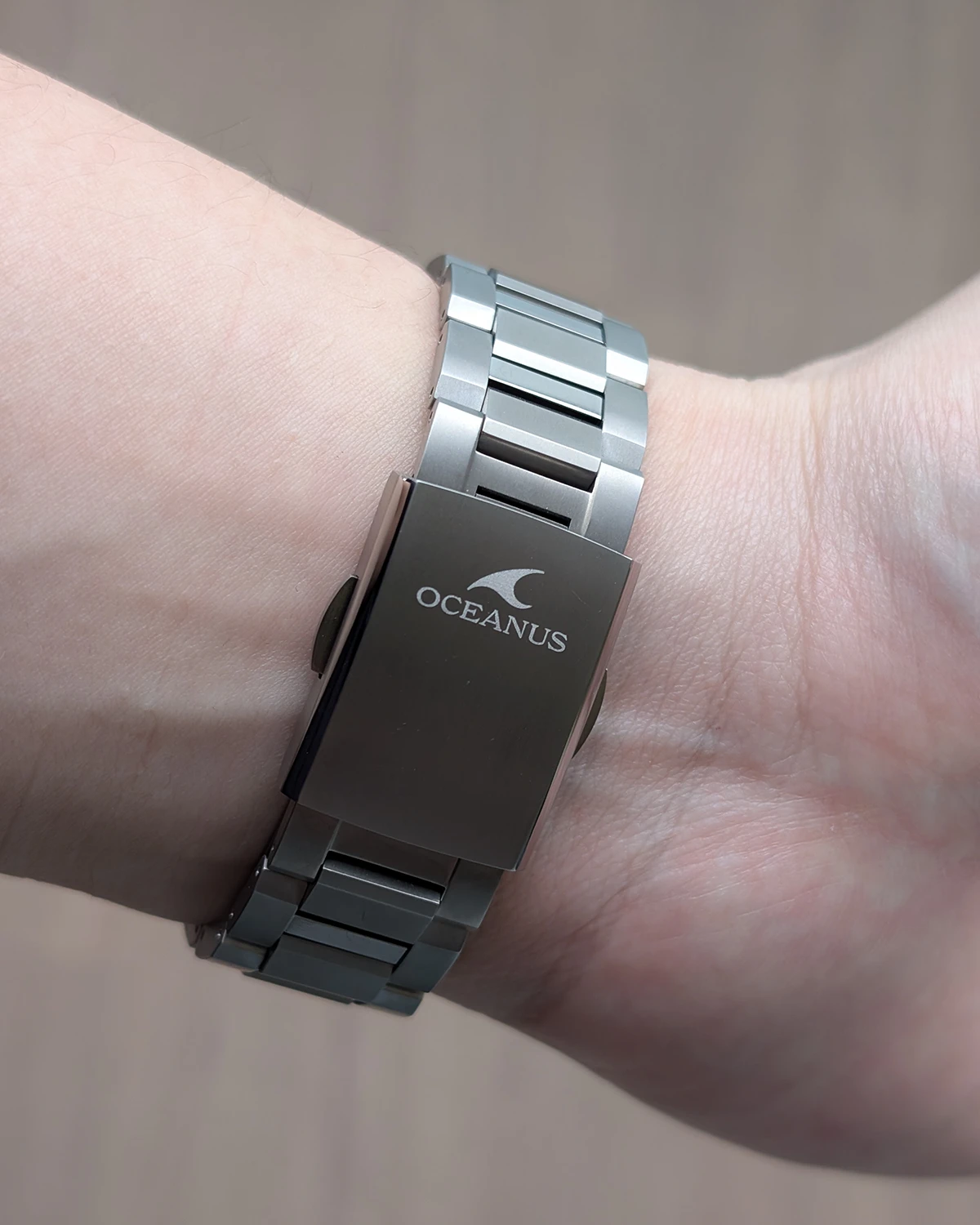
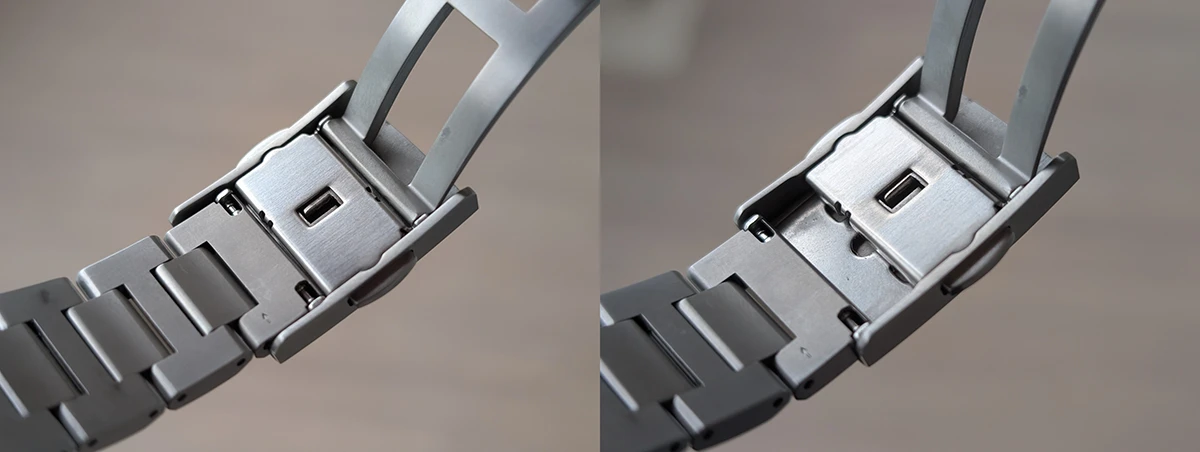
The bracelet features H-shaped links as its base, combined with separate mirror-finished parts to create a three-dimensional effect. The buckle is a tri-fold type that opens and closes with a push button, and also features a simple slide adjustment mechanism. The ability to adjust the fit on the spot to match the wrist circumference, which changes depending on the temperature and time of day, is practical.
A world timer that lets you enjoy manual operation.
What defines this watch's unique character is its newly developed time zone navigator. Its operation is unique. Pressing the button at the 10 o'clock position causes the second hand to point to a city in a time zone that is currently experiencing midnight. You then manually align the ▽ mark on the rotating bezel with that city code. This combination of city code and the 24-hour display on the bezel allows you to see the approximate current time in various parts of the world at a glance.
A typical GMT watch uses a GMT hand to read a second time zone. The OCW-P3000, on the other hand, excels at providing an overview of the approximate time in major cities around the world, rather than displaying the precise time in a single city, as a world timer.
What's most interesting is the whole process: pressing a button, checking the city indicated by the second hand, and then manually rotating the bezel to match. It's refreshing that Casio, which has automated many functions through electronic control, has deliberately left this final step to the wearer.
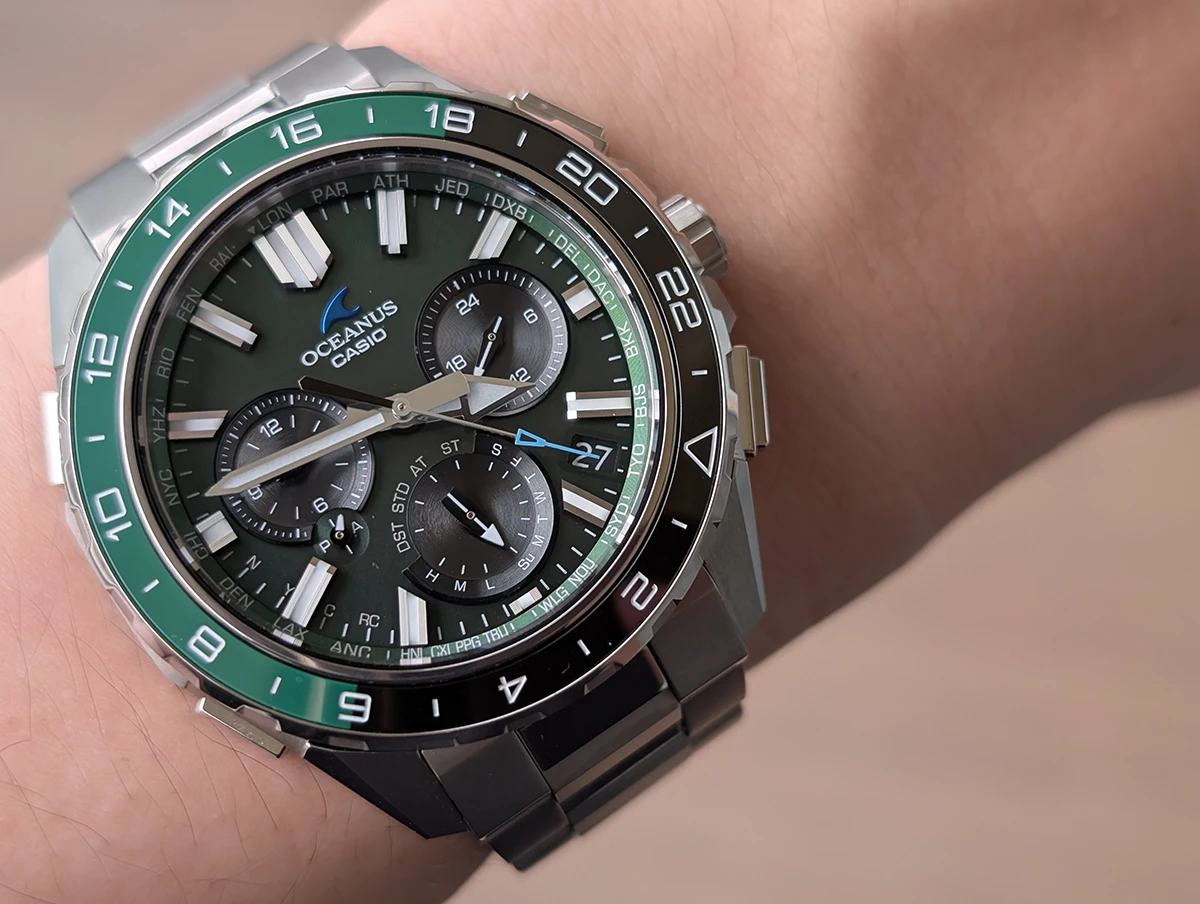
Also noteworthy are its extensive features.
Of course, it also boasts the multi-functionality characteristic of Oceanus watches. It supports Bluetooth smartphone linking and standard radio wave reception, allowing for automatic time correction without any extra effort. By connecting to the dedicated "CASIO WATCHES" app, you can set world time for approximately 300 cities, as well as adjust various watch settings and check the status, all from your smartphone.
Furthermore, it's worth noting that this model is the first Oceanus watch to feature "TOUGH MVT. 2." In addition to the automatic time correction, automatic hand position correction, and Tough Solar features of the previous "TOUGH MVT.", it now includes an automatic hand position correction function with shock detection and a magnetic field detection function. When it receives an external shock, it detects it and corrects the hand position, and when it detects a strong magnetic field, it temporarily stops the movement of the hands. Once it is out of the influence of the magnetic field, it automatically returns to the correct position.
This watch is designed to maintain accurate display without the user even noticing, even in today's world surrounded by smartphones and electronic devices. It further refines the effort required to use a wristwatch.
A design that suits any occasion and a lightweight feel.
What impressed me most when actually wearing it was how surprisingly lightweight it was, exceeding what its appearance might suggest. While the 42.9mm diameter might suggest a substantial case size, the titanium exterior keeps the weight down, and the thickness is a modest 11.7mm, making it comfortable to wear on the wrist for extended periods.
On the other hand, the two-tone ceramic bezel and the information-rich dial ensure that it has a strong presence as a wristwatch. Although sporty, the design is not overly playful, making it easy to wear not only on weekends but also in business settings where you would wear a jacket.
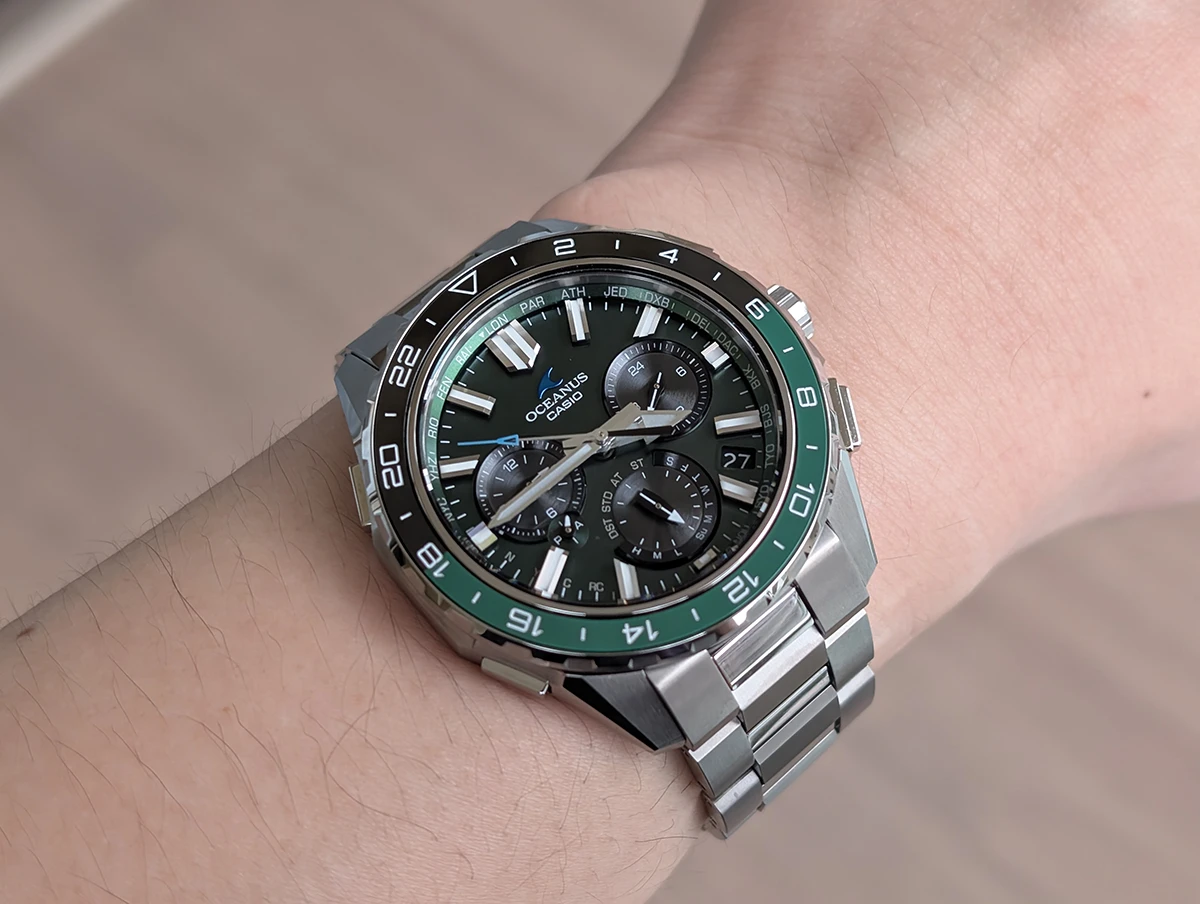
Despite its 42.9mm case diameter, the titanium exterior keeps the weight down to just 99g. The thickness is also a modest 11.7mm, resulting in a surprisingly light and comfortable feel on the wrist. Features Tough Solar power. Approximately 23 months of operation on a full charge (in power-saving mode). Titanium case (42.9mm diameter, 11.7mm thickness). 10 ATM water resistance. 22 yen (including tax).
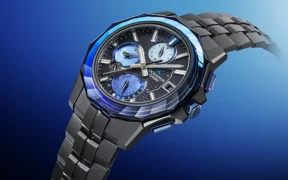
In addition to green, I also had the opportunity to try blue and black. The blue, in particular, is striking with its vibrant bezel color. The contrast between light and dark is strong, and of the three colors, it allows you to enjoy the sporty character of the Cacharo most directly.
In contrast, there's the black version. At first glance, it appears to be entirely black, but the bezel is finished in a black and gray two-tone. The color scheme is understated while retaining the function of day/night indicator, and combined with the DLC-coated exterior, it gives a sharp and sophisticated impression.
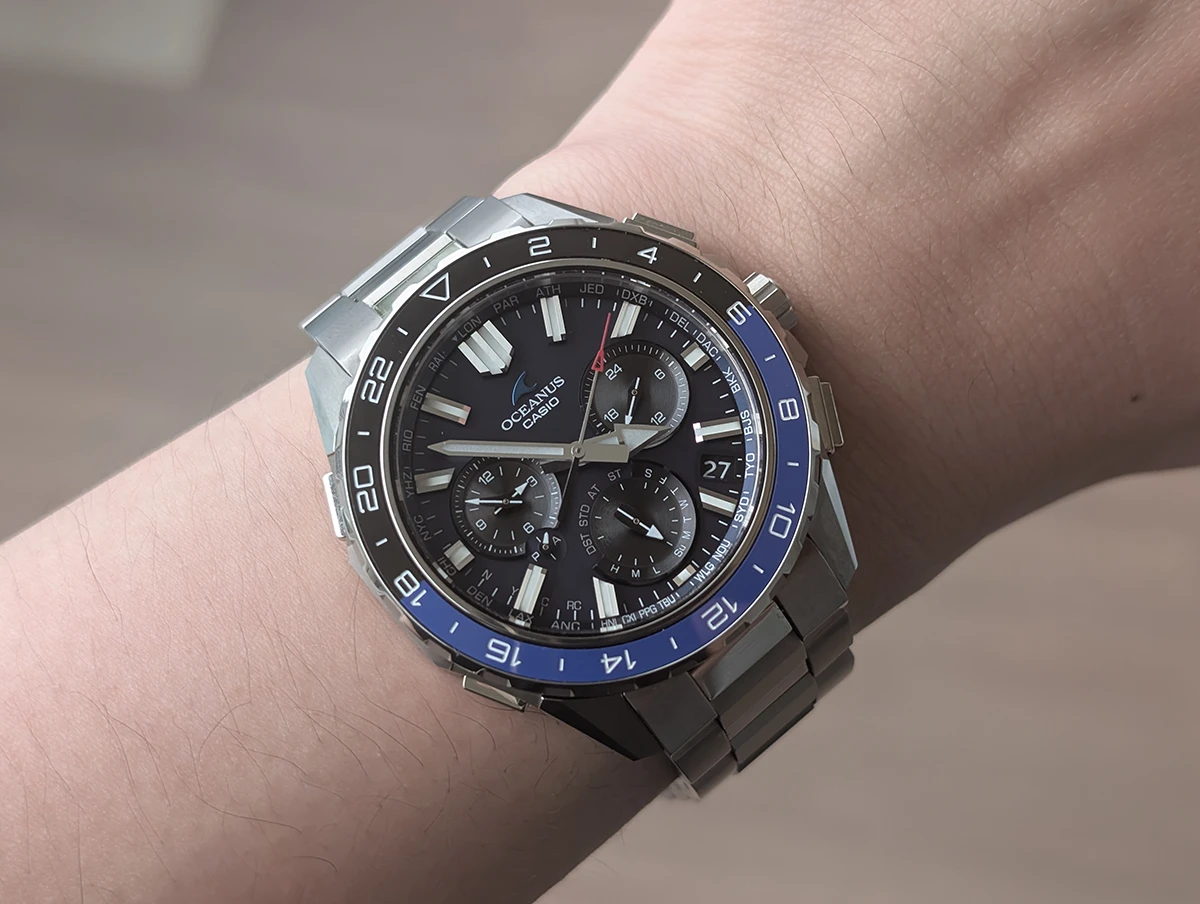
A model that makes the most of Oceanus' signature blue. The strong contrast of the bezel, which combines vibrant blue and black, allows you to directly enjoy the sporty character of the Cacharo. Tough Solar. Approximately 23 months of operation on a full charge (with power saving). Ti case (diameter 42.9mm, thickness 11.7mm). 10 ATM water resistance. 22 yen (tax included).
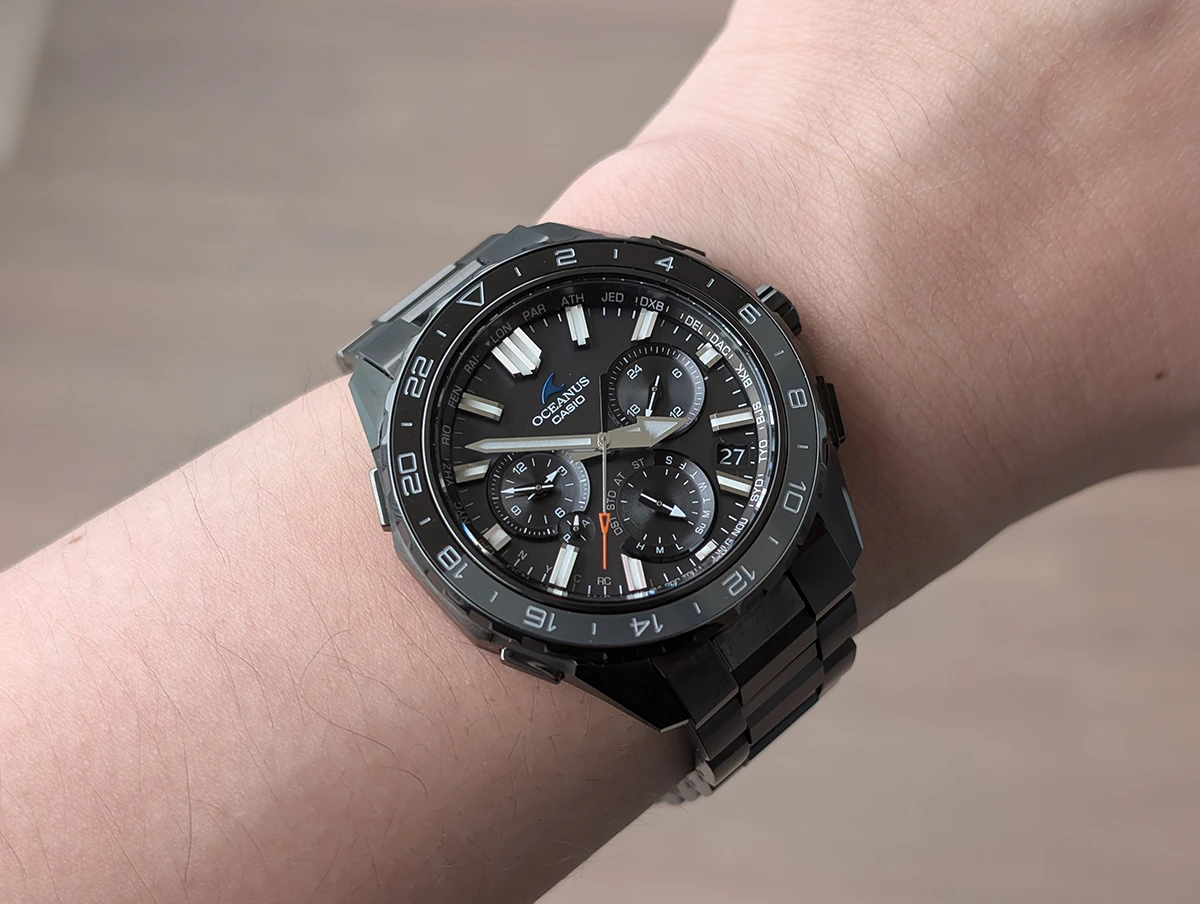
The black model combines a black and gray two-tone bezel with a DLC-coated titanium exterior. Of the three colors, it has a particularly sharp and refined appearance. It features Tough Solar power and approximately 23 months of operation on a full charge (with power saving enabled). It has a titanium case (42.9mm diameter, 11.7mm thickness) and is water-resistant to 10 atmospheres. Price: ¥253,000 (including tax).
On the other hand, green, which has recently been adopted by many brands and seems to have become a staple color, appears fresh in the context of Oceanus, whose brand color is blue. It is unique in that it asserts a distinct personality without being too flashy, and is clearly different from blue or black. If you want to choose one of the three colors that is a little different from the usual Oceanus, green is recommended.
Enjoy a dialogue with your watch at your fingertips.
Solar-powered radio-controlled watches are undoubtedly a convenient category of timepieces. They charge as long as there is light, and the time is automatically corrected by receiving standard radio waves. The OCW-P3000 even has Bluetooth, so there are very few situations where the user needs to touch the watch.
However, when viewing a wristwatch as a hobby item, many people will likely find its convenience somewhat lacking. One reason why mechanical watches still enjoy such enduring popularity is that the effort involved in winding the mainspring and setting the time—efforts not necessarily required for practical use—creates a sense of enjoyment in interacting with a wristwatch.
The uniqueness of the OCW-P3000 lies in its aim to balance aesthetic appeal with practicality. You press a button when needed. The second hand moves. Then, relying on its instructions, you rotate the bezel with your fingertips. The bezel, crafted from ceramic and titanium, moves smoothly, and the time in various cities around the world appears before your eyes. This operation involves a dialogue with the wristwatch born from inconvenience.
What makes this work is that the world timer isn't a function you use frequently. You can use it conveniently as a solar-powered radio-controlled watch most of the time, and only enjoy the analog operation when needed. Not having to accept everyday inconvenience for the sake of a hobbyist feature strikes a good balance from a practical standpoint.
It's convenient, yet it doesn't feel impersonal. This sense of distance is perhaps the charm of this watch. By using the classic mechanism of a rotating bezel to revive the joy of operating a watch, which is often lost in the midst of convenience, this watch is a world timer that is typical of Oceanus, achieving a high level of balance between functionality and aesthetic appeal.