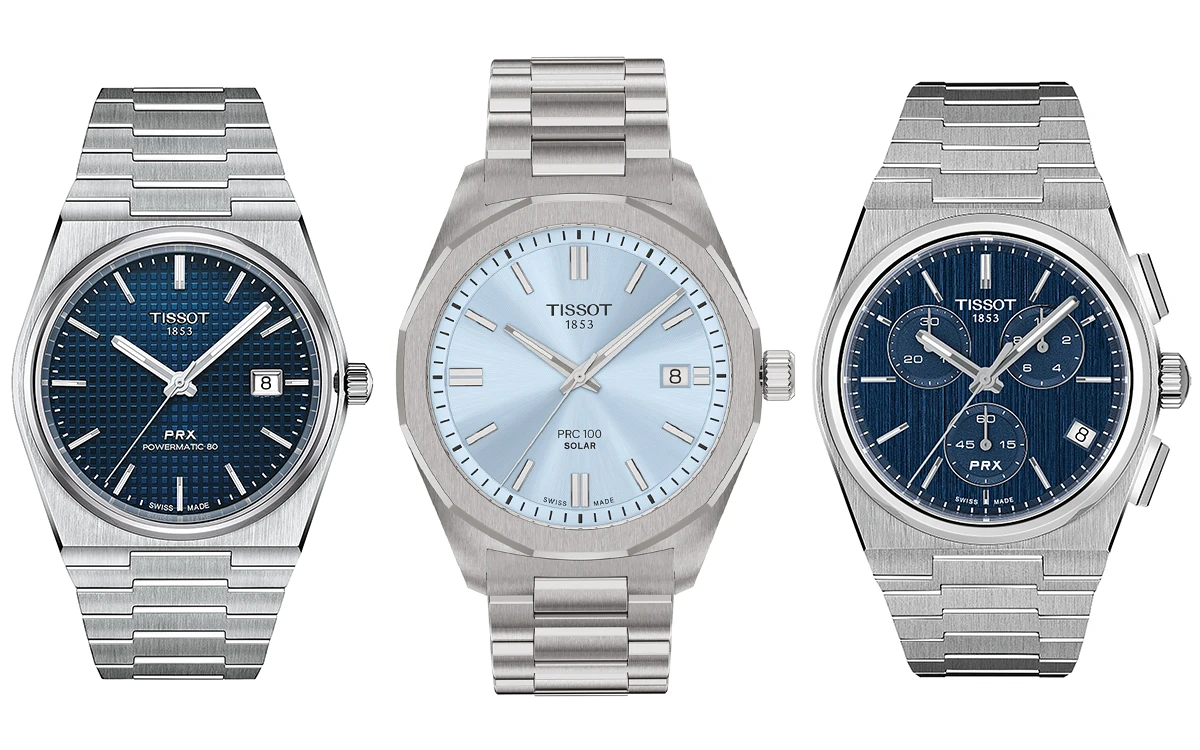
In this article, watch writer Shinichi Sato recommends Tissot watches, boasting a wide range of designs and high-performance movements, for men in their 20s considering purchasing their first wristwatch. Focusing on the popular "Tissot PRX" series, known for its edgy and cohesive sporty design, he will also explain the history of each model and the characteristics of the movements they feature.
Text by Shinichi Sato
[Article published on January 29, 2026]
If you're buying your first watch, you should definitely check out Tissot.
If I were to be reincarnated as a man in his twenties while retaining my knowledge as a watch writer, the watch I might choose within my limited budget is a Tissot. The reason for this is its extensive lineup, diverse design options, highly practical movements, and reasonable pricing, thanks to the scale advantages of being part of the Swatch Group. In this article, I will introduce specific recommended models for men buying their first wristwatch, and explain why watch writer Shinichi Sato is paying attention to Tissot.
"Tissot PRX Automatic" Ref. T137.407.11.041.00

Automatic winding (Cal. Powermatic 80). 23 jewels. 21,600 vph. Power reserve approximately 80 hours. Stainless steel case (diameter 40mm, thickness 10.93mm). Water resistant to 10 bar. 107,800 yen (tax included).
First up are the various models from Tissot's popular "Tissot PRX" collection. The first is the "Tissot PRX Automatic" Ref. T137.407.11.041.00, which can be considered the core model of the PRX. The PRX is characterized by its integrated design, with the case flowing seamlessly into the bracelet. The sharp case is paired with a round bezel, achieving a balance between sportiness and refinement. The exterior is based on a finely textured satin finish, with a polished finish applied to the bezel and the beveled edges of the case to create contrast. These differences in gloss enhance the contours and three-dimensionality of the case, making it a pleasure to admire the details.
The origins of this design lie in a model that appeared in 1978 as part of the "Seastar" collection. The original model was characterized by its smoothly connected case and bracelet silhouette, as well as practical features such as water resistance and magnetic resistance. The current PRX, which appeared in 2021, revives that design for the modern era.
The PRX Automatic, equipped with a mechanical self-winding movement, also features a striking three-dimensional grid pattern on its dial. The blue dial of this model subtly changes its appearance depending on the direction and intensity of the light and the viewing angle. A date display is located at the 3 o'clock position.
In addition to its design, what makes this watch particularly noteworthy as a first mechanical timepiece is its Cal. Powermatic 80 movement. Mechanical watches are powered by the unwinding force of a wound mainspring, so they will eventually stop if left unattended. In contrast, this watch boasts a power reserve of approximately 80 hours when the mainspring is fully wound. Therefore, if fully wound, it will continue to run until Monday morning even if taken off on Friday night, making it highly convenient. Furthermore, the balance spring, which is responsible for accuracy, uses Nivacron, which is resistant to magnetic fields. In today's world, where magnetic electronic devices such as smartphones and PCs, and magnetic clasps on bags are commonplace, this anti-magnetic feature is not to be overlooked.
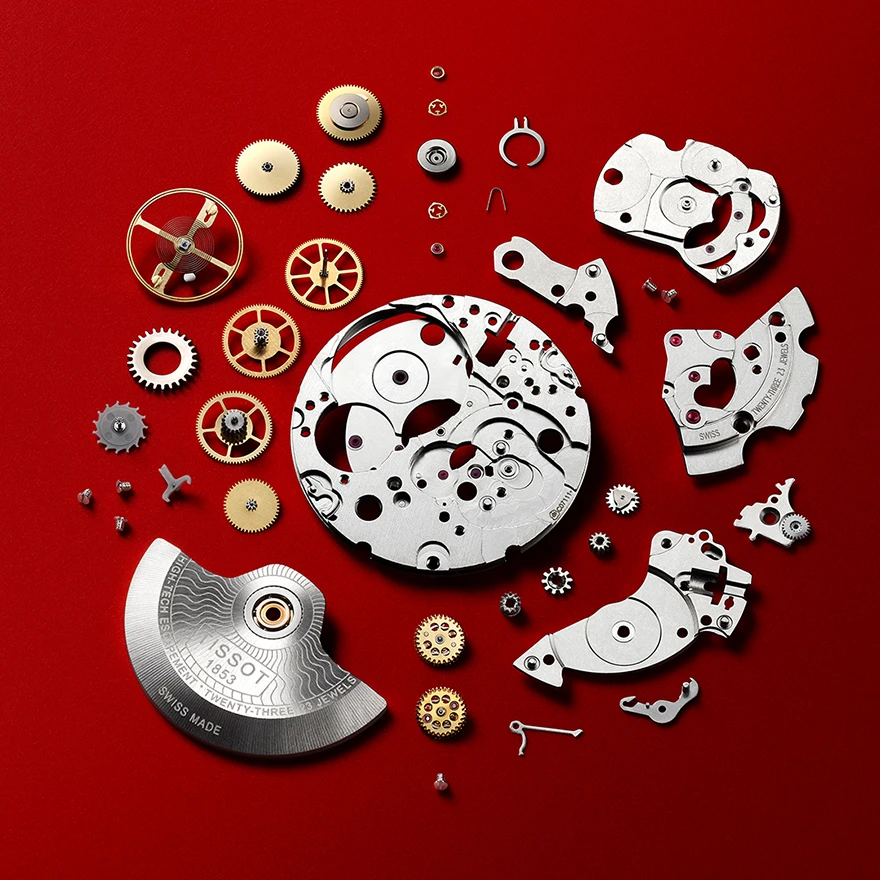
Tissot has released the PRX Automatic, which incorporates such a high-performance movement into a stylish design, for 118,800 yen (including tax). The reason Tissot can achieve such a reasonable price is that it is part of the Swatch Group. The group owns movement manufacturers such as ETA and has a foundation from technological development to production. Tissot leverages its technical capabilities and economies of scale to achieve both quality and affordability. This is a major reason why Tissot is a good choice for a first wristwatch.
In addition to the 40mm case diameter model, the PRX Automatic is also available in a more compact 35mm model, so you can choose the one that best suits your physique.
Tissot PRX Powermatic 80 Titanium 38mm Ref. T137.807.44.061.00

Automatic winding (Cal. Powermatic 80). 23 jewels. 21600 vibrations/hour. Power reserve of approximately 80 hours. Titanium case (38mm diameter, 10.98mm thickness). 10 ATM water resistance. 141,900 yen (tax included).
If you want a compact and lightweight version of the PRX design, you should check out the "Tissot PRX Powermatic 80 Titanium 38mm" Ref. T137.807.44.041.00. This model features a titanium case and bracelet, and a 38mm case diameter. The difference is most noticeable in its weight. While the previously mentioned stainless steel 40mm model weighs 138g, this model weighs 84g, which is about 4% lighter, although this comparison includes size differences.
The seamless, integrated design characteristic of the PRX series, from the case to the bracelet, is present in this model as well. Furthermore, even though it's made of titanium, you can enjoy the choice between satin and polished finishes. On the other hand, it's worth noting that, unlike the stainless steel model, it exhibits a darker hue than silver, resulting in a sportier finish.
The watch is paired with a gray dial featuring a three-dimensional waffle pattern. The gold-colored hands and indices give it a sporty yet chic design, characteristic of the PRX series.
The price for this titanium watch, which also features the Cal. Powermatic 80 movement, is 141,900 yen (including tax). The fact that they have kept the price difference down despite using titanium, which is difficult to process due to its toughness and tends to be expensive, gives a glimpse into Tissot's watchmaking capabilities.
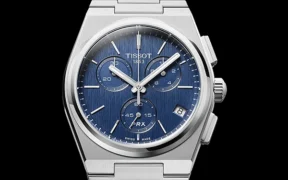
Tissot PRX Quartz Chronograph Ref. T137.417.11.041.00
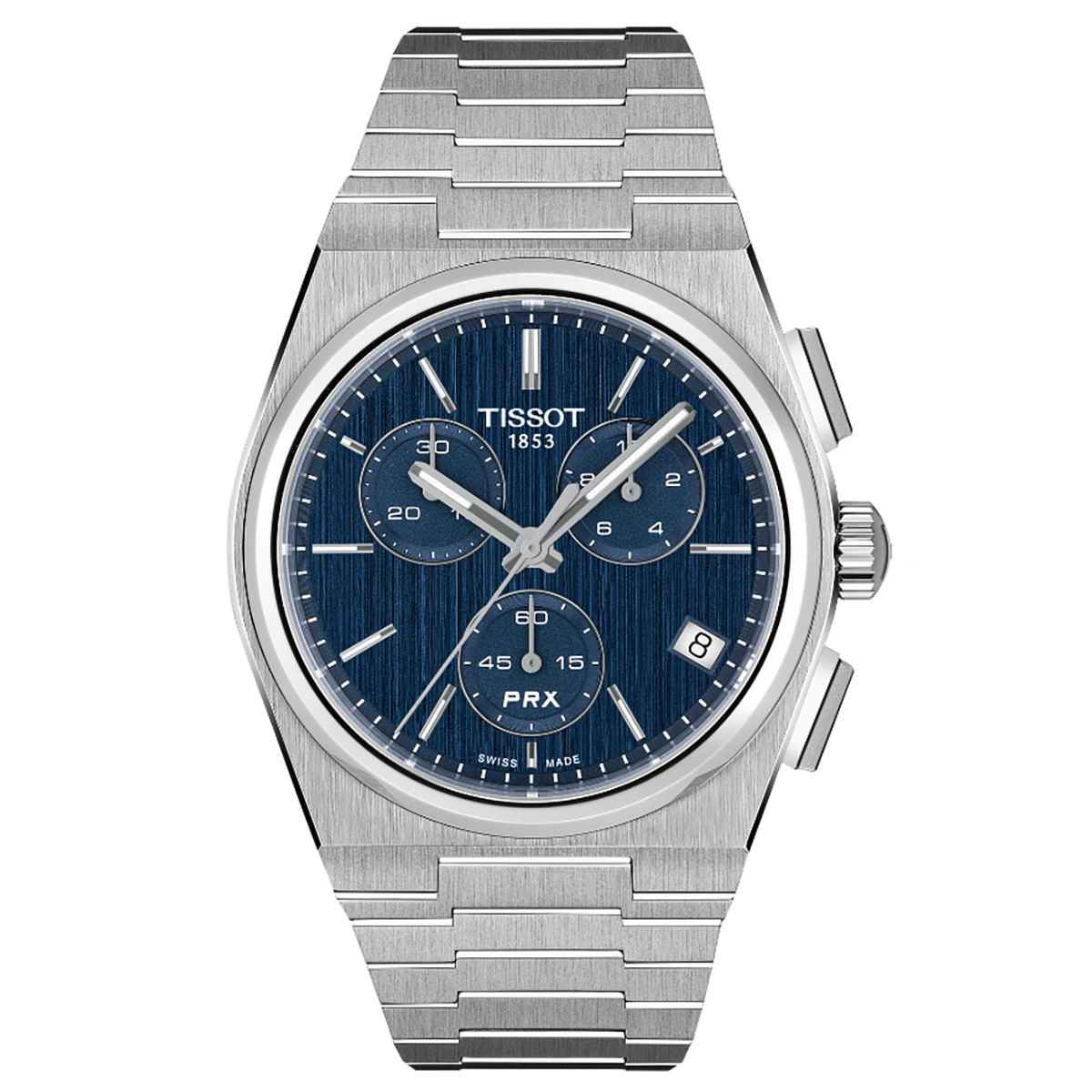
Quartz movement (Cal. G10.212). Stainless steel case (41.00mm diameter, 11.65mm thickness). 100m water resistance. 75,900 yen (tax included).
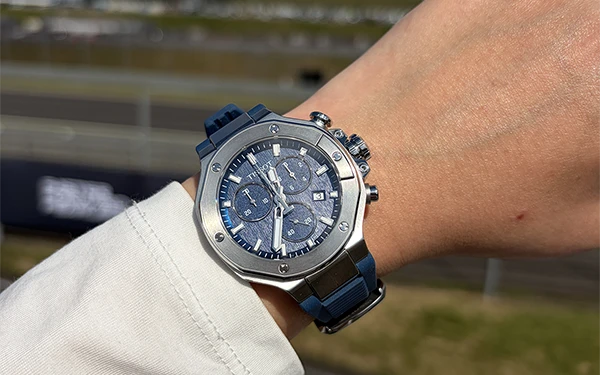
The PRX series also includes models equipped with a chronograph (stopwatch) function. While retaining the styling of the PRX, these models boast a sporty design with multiple sub-dials and push buttons. The model we're highlighting this time is the quartz chronograph model, the "Tissot PRX Quartz Chronograph" Ref. T137.417.11.041.00.
The center of the watch features hour and minute hands along with a chronograph seconds hand. The chronograph seconds hand activates when the push button at the 2 o'clock position is pressed to start the measurement, and it displays the elapsed time in seconds. The seconds for the regular time are displayed on the sub-dial at the 6 o'clock position. When the chronograph seconds hand completes one rotation and one minute has elapsed, the 30-minute counter at the 10 o'clock position advances by one increment. Furthermore, a 1/10th of a second counter is located at the 2 o'clock position, and when the measurement is stopped, these displays can be combined to read the elapsed time to the nearest 1/10th of a second. The chronograph function is stopped by pressing the push button at the 2 o'clock position again, and reset by pressing the push button at the 4 o'clock position.
One notable feature that sets this PRX apart from other models is the vertical brushed finish on the blue dial. This distinctive brushed finish creates a contrast with the matte sub-dials and the sharp edges of the hands and indices, while also complementing the satin finish of the case.
Tissot Visodate Ref. T157.407.11.051.00
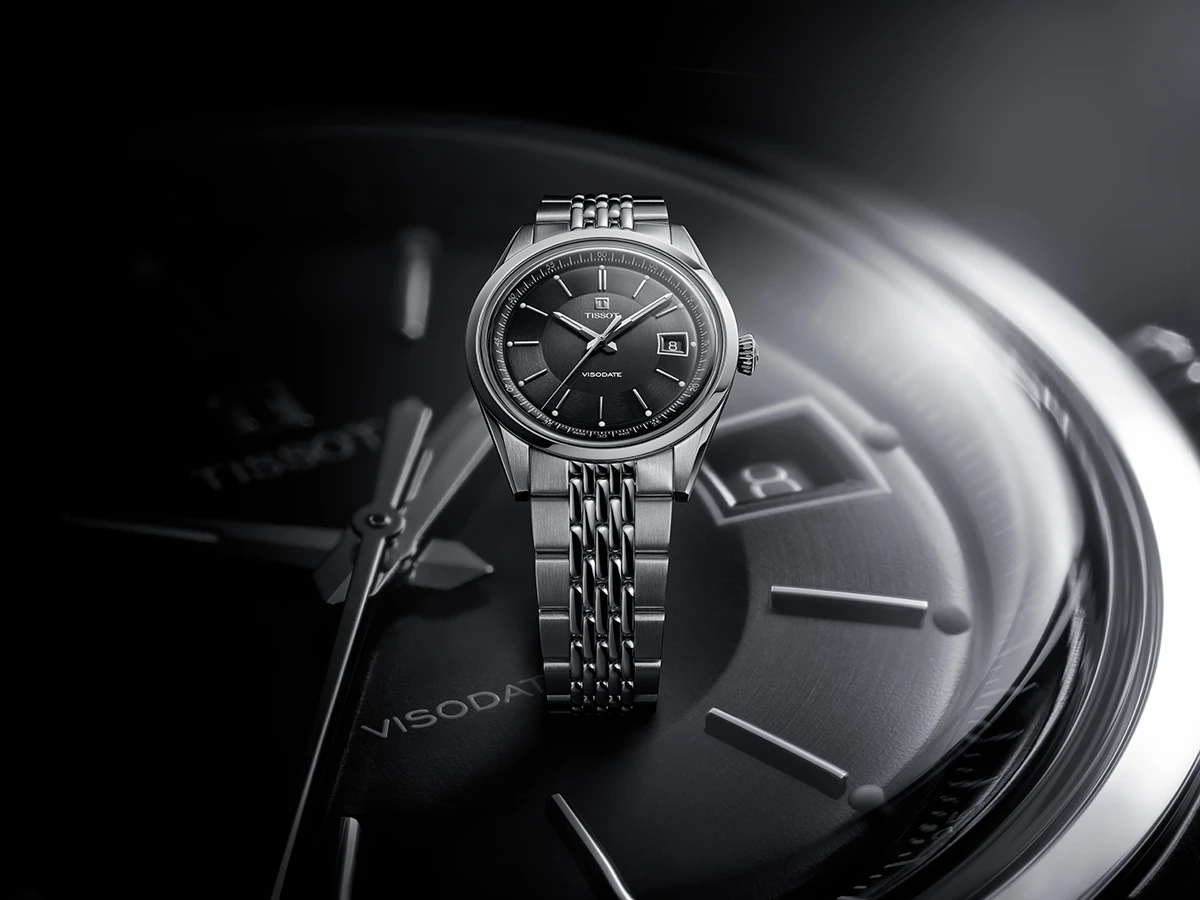
Automatic winding (Cal. Powermatic 80). 23 jewels. 21,600 vph. Power reserve approximately 80 hours. Stainless steel case (diameter 39.00mm, thickness 10.45mm). Water resistant to 50m. Price: 185,900 yen (tax included).
If you're looking for a more chic and classic design, I recommend the Tissot Visodate Ref. T157.407.11.051.00. The Visodate is a collection that inherits the lineage of the date-display model released in 1954. This model also follows that design, employing a domed dial and a box-shaped sapphire crystal that rises from the case. When viewed from an angle, the three-dimensionality of the dial and the roundness of the crystal stand out, making it even more appealing for its classic design. The print surrounding the date window at the 3 o'clock position is also an homage to the original model. And the bracelet is another highlight. It uses a so-called rice bracelet, made up of small links resembling grains of rice. The delicate appearance, different from the wider links of the PRX, enhances the overall classic atmosphere of the watch.
On the other hand, it's not simply a reproduction of past watches. The silhouette, which creates a sense of unity from the case to the lugs, is combined with satin and polished finishes, adding a modern touch. The dauphine-shaped hour and minute hands, which taper sharply towards the tip, and the fine seconds scale on the outer edge of the dial are also elements that have been incorporated as modern refinements. As another modern feature, the bracelet uses a quick-release system that can be removed without tools, allowing you to choose a style that suits the occasion.
It is equipped with the same automatic movement, Cal. Powermatic 80, as the PRX Automatic mentioned earlier. The appeal of the Tissot Visodate lies in its combination of classic styling reminiscent of the 1950s and modern performance.
Tissot PRC 100 Solar Ref. T151.422.11.351.00

Solar-powered quartz movement. Approximately 14 months of operation on a full charge. Stainless steel case (39.00mm diameter, 9.22mm thickness). 100m water resistance. 79,200 yen (tax included).
Finally, we introduce the Tissot PRC 100 Solar, a watch recommended for those who prioritize ease of use in everyday life. This model is a quartz watch that generates power from light and is powered by that electricity, and its distinctive dodecagonal bezel is its iconic feature. The Ref. T151.422.11.351.00 we've picked out is a model with a refreshing ice blue dial. The bright, vibrant ice blue is combined with a simple display of hours, minutes, seconds, and date.
To achieve both the beauty of the dial and the convenience of light-powered technology, Tissot developed its unique "Lightmaster Solar Technology." While typical light-powered models place the solar cell beneath the dial, this requires light to pass through, limiting the materials and finishes used. In contrast, this model features a honeycomb-like arrangement of tiny solar cells inside the sapphire crystal. This structure allows for the use of metal dials that do not transmit light, resulting in a design with vibrant colors and a metallic texture.
This Lightmaster Solar Technology ensures sufficient power generation not only from sunlight but also from indoor lighting. In an environment of 5000 lux, equivalent to an outdoor cloudy day, approximately 10 minutes of light exposure can provide enough power for 24 hours, and a full charge allows it to operate for approximately 14 months. Furthermore, when the charge is low, the second hand moves at 4-second intervals to indicate that light is needed. If you wear it regularly, the chances of the watch stopping are quite low. While I hope that you will cherish and wear your watch every day once you've bought it, if you think you might not wear it very often, why not consider this model?