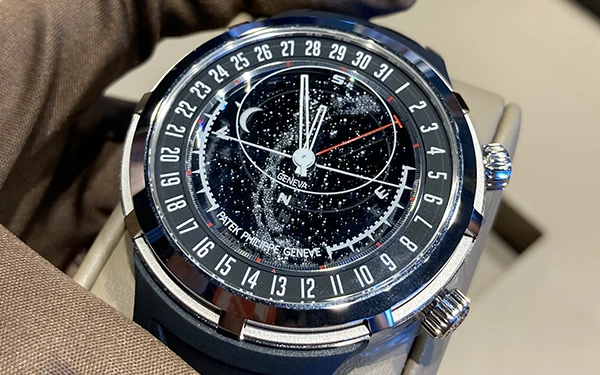

Patek Philippe is a long-established brand that continues to reign at the top of the watch industry. We will explore its glorious history and introduce a model equipped with a minute repeater, which is classified as an ultra-complex mechanism.

Minute repeater, one of the three major complications
Throughout history, there have been many groundbreaking inventions in the field of watches, but the most important of these are the three great complications: the perpetual calendar, the tourbillon, and the minute repeater.
Here we will explain the minute repeater, the oldest of the three major complications.
Repeater that announces the time
In the days when lighting was underdeveloped, it was difficult to check the time on a clock in the dark. To address this issue, the "repeater," which is said to have been invented in England in the late 17th century, would sound the time when operated at will.
In environments where visibility was not possible, a mechanism was developed to ring a bell to tell the time: the "repeater."
A repeater is a complication that tells the time by striking a gong with the push button and slide piece or lever.
The minute repeater complication
The repeater mechanism, which tells the time by sound, is said to have been invented by British watchmakers Daniel Quayle and Edward Barrow.
Initially, they were installed in table clocks, but at the end of the 18th century, Abraham-Louis Breguet replaced the bell with a ring-shaped gong and placed it on the outside of the movement, which led to it being installed in thin pocket watches as well.
Abraham-Louis Breguet came up with the idea of replacing the chiming mechanism with a ring-shaped gong, which, when placed on the outside of the movement, created the pocket watch repeater.
This method remains the basis for repeater watches to this day.
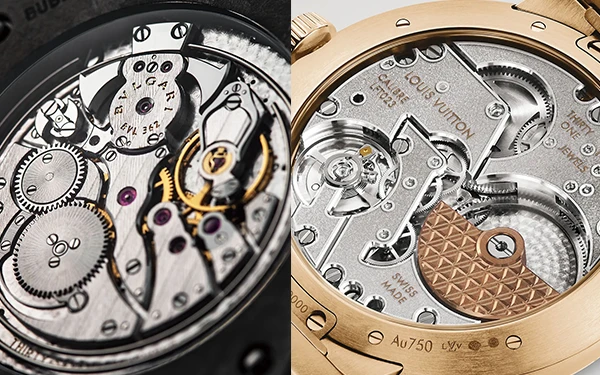
Furthermore, in order to combine the sounds of multiple bells, an extremely complex structure was meticulously constructed within the small case, resulting in the creation of a minute repeater that could be used to strike every minute.
General sound effects
The mechanism that produces the sound is equipped with two hammers and a ring-shaped gong that is tuned to produce a low and a high tone. When the operating lever is operated, power is supplied to the mechanism, causing the hammers to strike the gongs. The strike sound signals the time that has passed at the time the mechanism is operated.
The notification times and sound combinations are as follows:
- Hour (1 hour intervals): Low tone. Up to 12 times according to the hour.
- Quarter (15-minute intervals): 1 set of high and low notes. Up to 3 sets up to 45 minutes.
- Minutes (1 minute intervals): High tone. Up to 14 times per minute.
For example, if the time is 12:59, the clock will first chime 12 times with a low tone, followed by three sets of high and low tones (45 minutes), and then 14 high tones to make 59 minutes (45 minutes + 14 minutes).
Patek Philippe: A Revolution
Here, we would like to delve deeper into Patek Philippe, which has a lineup of models equipped with the complex mechanism of a minute repeater.
One of the world's three major watch brands

Patek Philippe was founded in Switzerland in 1839. It was founded by Antoine Norbert de Patek and François Czapek, two Polish aristocrats who had fled the country. At the time, the company was called Patek Philippe.
The company, which had the motto of "making the best watches in the world," initially focused on selling high-end key-wound pocket watches. In 1844, watchmaker Jean-Adrien Philippe joined the company, and the company brought about various innovations to the watch industry.
Philippe, known as a genius inventor, developed the crown time-setting mechanism and mainspring winding mechanism, and in 1845 produced the company's first minute repeater.
At the Great Exhibition in London in 1851, the world's first keyless clock was praised by Queen Victoria of England, and since then, aristocrats and world-famous celebrities have been added to its customer list.
Today, it is considered one of the world's three major watch brands, thanks to its beautiful finish based on its history and high level of technology, and the high quality that meets the strict internal regulations of the Patek Philippe Seal (applied since 2009; previously it complied with the Geneva Seal).
Cathedral gongs dramatically improve sound quality

Patek Philippe's minute repeater first astonished the world in 1910 when it developed the "Prince of Reglas," an ultra-complex pocket watch that replicated the Westminster chimes.

Making minute repeater gongs has traditionally required highly skilled expertise, but the transmission of this skill was temporarily lost in the 1970s. Patek Philippe then re-established the knowledge and methods of gong making, and in the early 2000s, introduced its unique "cathedral gongs," dramatically improving the sound quality of the gongs.
The cathedral gongs are roughly twice as long as conventional gongs, and offer a rich tone and a long resonance reminiscent of the gold of a temple. This invention established Patek Philippe as the king of minute repeater manufacturing.