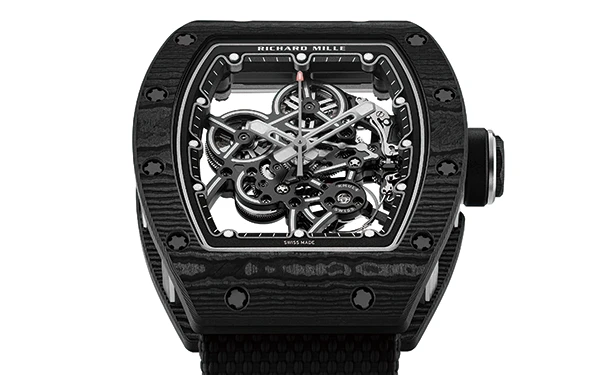

The Richard Mille RM 027 Tourbillon Rafael Nadal, released in 2010, revolutionized the concept of luxury watches with its lightness and robustness. Ten years later, Richard Mille has released the new RM 27-04 Tourbillon Rafael Nadal, which offers even better performance. Its shock resistance is 12,000G. However, what is amazing about this model, beyond its shock resistance and price, is that it is impossible to imagine how it is made.

Text by Masayuki Hirota (Chronos-Japan)
I can't imagine how it was made
The new Nadal model is a departure from previous models
Richard Mille's new Nadal model, the RM27-04 Tourbillon Rafael Nadal, has been featured many times in this magazine and on Web Chronos. As mentioned in the previous issue, this model has a shock resistance of 12,000 g thanks to an improved design of the RM27-01, which supports the movement with wire.
I have looked at all of Nadal's previous models and have been amazed by each one. In terms of lightness, the original RM 027 and RM 27-01 are outstanding, but the approach taken by subsequent models to combine lightness and impact resistance has been even more intriguing.

Following the RM 027's pursuit of lightness, its successor, the RM27-01, sought to achieve both lightness and shock resistance. This was manifested in the unique idea of supporting the movement with metal wires. However, the subsequent RM27-02 and RM27-03 saw a complete reversal in the direction of increased rigidity and shock resistance. The structure of molding the case and movement baseplate as a single unit to enhance rigidity is something only Richard Mille, which processes both the interior and exterior with the same precision, can achieve. Looking at the RM27-03, which boasts a shock resistance of 1 g, I honestly thought that the Nadal model couldn't have evolved any further.
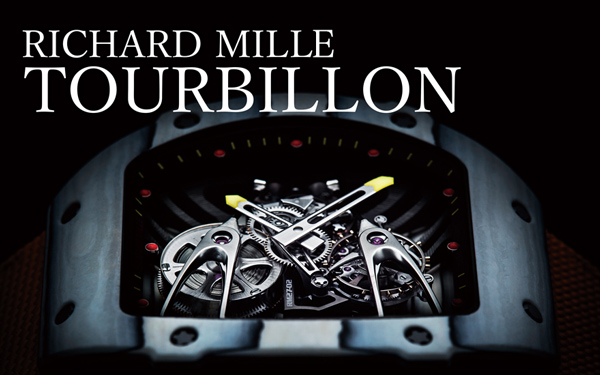
However, with the 2020 RM27-04, Richard Mille completely defied expectations. The approach that resulted in a shock resistance of 12,000 g is truly intriguing. The movement baseplate, which extends from 1 o'clock to 7 o'clock, is fixed to the movement holder to provide vertical support. Meanwhile, the wire woven like the strings of the racket acts as a suspension, absorbing impacts primarily in the lateral direction. It's no exaggeration to say that this design is the culmination of Nadal's models. I never imagined they would simultaneously incorporate a design that increases rigidity and a structure that absorbs shock with suspension.
However, what surprised me more than the design was the amount of effort that went into it. The RM27-01 also supported the movement with metal wires, which were passed around the movement and secured to the case. In contrast, this model incorporates the movement into a web of wires. The reason for this complicated structure is to support the movement at multiple points. The movement is secured to the wires at five points with wing-like hooks extending from the baseplate, and at three shock-resistant devices at the barrel arbor, second arbor, and carriage center. Other companies could certainly imitate this if they wanted to, but the wires would undoubtedly damage the components. I took a nasty look at the movement, and could not find a single scratch.

This model commemorates the 10th anniversary of the release of the "Rafael Nadal" model. The movement is suspended by a cable suspension system, achieving shock resistance of 12,000 g, 20% more than the previous model. The case is made of TitaCarb®, a polymer with the highest level of durability. Weighs approximately 30 g. Manually wound (Cal. RM27-04). 19 jewels. 21,600 vph. Power reserve of approximately 38 hours. TitaCarb® (47.25 mm x 38.4 mm, 11.4 mm thick). Water resistant to 50 m. Limited to 50 pieces worldwide. Priced at 115 million yen.
Incidentally, Richard Mille chose to first loosely weave the wire, then tighten it after the movement is secured in place. While it's possible to thread the wire through while assembling the movement, this is completely impractical. While weaving the wire first theoretically makes assembly easier, the bent metal wire would likely scratch the components. It's hard to imagine how Richard Mille managed to avoid this, but that's exactly what they did.
The case material chosen for this watch is TitaCarb®, a high-performance polyamide often used in automobiles, aviation, and medical equipment, enhanced with carbon for enhanced durability. The bezel, case band, and case back fit together so precisely that upon seeing the actual watch, I mistakenly thought it was a one-piece case. It's also worth noting that the bezel was hollowed out as much as possible, achieving both weight reduction and visual impact. Richard Mille has been improving the precision of its cases year after year. However, I never imagined they could achieve such precision with a curved case. Again, I can't imagine how they managed to achieve the right dimensions.
The new Nadal model has been attracting attention for its extraordinary shock resistance of 12,000 g and its price tag of over 100 million yen. However, what surprises me is something else entirely. It is something that sets it apart from anything that has come before, in that it is impossible to imagine how it was made. The RM27-04 has reached a completely different level from current watchmaking. To be honest, who would have expected the Nadal model to grow into something like an out-of-place artifact?

http://www.webchronos.net/features/58016/
http://www.webchronos.net/iconic/17446/

http://www.webchronos.net/features/51301/