
Q: Does temperature change affect the watch?
Although it is less noticeable nowadays due to advances in materials, most hairsprings are made of metal, and their hardness changes depending on the temperature. As a result, they often tended to run slower on hot days and faster on cold days.

A: If it is too high, it will tend to be slower, and if it is too low, it will tend to be faster, which will affect accuracy.
There are three major enemies of watches (especially mechanical watches): water, magnetism, and shock. However, there is another thing that has a surprisingly large effect: temperature. Although it is not so noticeable now, in the past it was common for changes in temperature to affect the accuracy of a watch. Specifically, when the temperature rises, the watch slows down, and when the temperature drops, the watch speeds up.
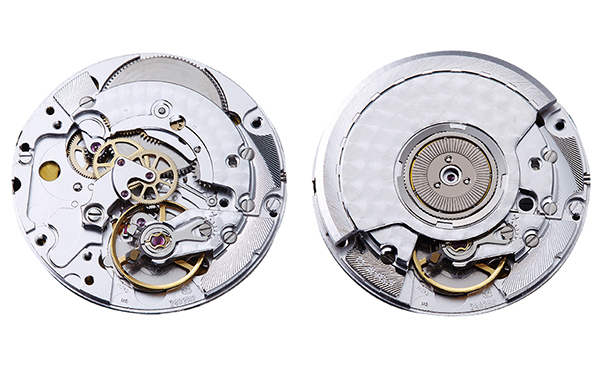
Basically, all mechanical watches have a balance wheel that acts as a pendulum and a hairspring that returns it to its original position. Most hairsprings are made of metal and are only as thick as a hair. Therefore, hairsprings from the past were very susceptible to the effects of outside temperatures.

This is because metals become softer when the temperature is high and harder when the temperature is low. In other words, when it gets hot, the balance spring becomes softer and the watch tends to run slower, and when it gets cold, the balance spring becomes hard and the watch tends to run fast. Incidentally, some old observatory chronometers automatically change the inertia of the balance wheel to match the expansion and contraction of the balance spring, thereby compensating for temperature. However, there are almost no mass-produced models that are equipped with such a system.

The same thing happened with old quartz watches, where the time would go fast or fast when the temperature changed. However, in the 1980s, a temperature compensation function was added, allowing quartz watches to maintain a consistent accuracy even when the temperature changed.
Today's mechanical watches are less susceptible to temperature changes than previous models due to improved hairspring materials. Silicon hairsprings in particular are said to be resistant to temperature changes. Traditional metal hairsprings, such as those using Anachron, Straumann hairsprings, Rolex's Parachrom hairspring, and Seiko's Sproon hairsprings, are also said to be resistant to temperature changes. Even mechanical watches that look the same have seen significant changes in performance over the past 20 years.

http://www.webchronos.net/comic/20499/

http://www.webchronos.net/features/52702/

http://www.webchronos.net/features/37951/