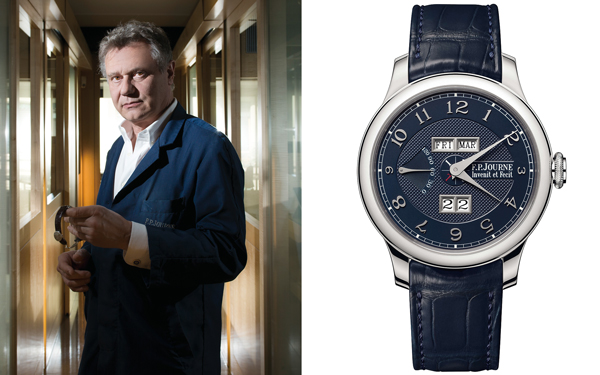
FP Journe watches are highly prized by discerning watch enthusiasts and collectors, but behind them lies a watchmaker unlike any other in the industry.

Edited by Kouki Doi (Chronos-Japan)
[Article published in the July 2023 issue of Kronos Japan]
"It's easy to make something complex, but difficult to make something simple"

FP Journe watches are extremely rare. The small Geneva-based brand produces around 900 watches per year and has almost no presence in Germany. However, it's worth keeping an eye on the manufacture, as behind it lies one of the greatest and most highly regarded watchmakers in recent watchmaking history.
François-Paul Journe does not fit the typical image of a watchmaker or brand founder. Born in Marseille, he is French, not Swiss, and began his "training" as a watchmaker at the age of 14. He started his own business early on, rather than working for a major manufacturer or group. His attendance at the Paris Watchmaking School, which he completed in 1976, was merely a means to an end, and he says that graduating felt like liberation.
In 1877, he began working for his uncle, Michel Journe, who ran a workshop in the Saint-Germain-des-Prés district of Paris, restoring antique table, wall, and pocket clocks. His talent blossomed there. François-Paul Journe's fascination with mechanical watches began during the so-called "quartz crisis" in Switzerland, when watchmakers were losing their jobs. While hundreds of watchmakers and suppliers across the Alps were forced to close, the young Frenchman began work on his first tourbillon in 1878 and completed it about five years later. By this time, he had already become deeply fascinated by the great watchmakers of the late 18th and early 19th centuries. The tourbillon is a mechanism developed by Abraham-Louis Breguet (1747-1823) in the late 18th and early 19th centuries.

After studying under his uncle for eight years, François-Paul Journe opened his own workshop on Rue de Verneuil in Paris. In the late 1980s, Swatch was all the rage, and there were still only a few collectors of mechanical and complicated watches. However, in France, enthusiasts in this field would visit Michel Journe's workshop to request repairs and restorations, and soon the talented watchmaker's nephew was offered work.
In addition to restoration work, he was also increasingly commissioned to develop complicated timepieces. Taking inspiration from the famous pieces Breguet had made for Marie Antoinette, he created a number of works, including astronomical pocket watches, retrograde perpetual calendars, equations of time displays, constant-force devices using fusee-and-chains, and pocket watches with chronometer escapements. Since then, he was constantly surrounded by examples of his own making, but rather than simply reproducing them, he would tinker with them, improving them technically by tweaking their details.
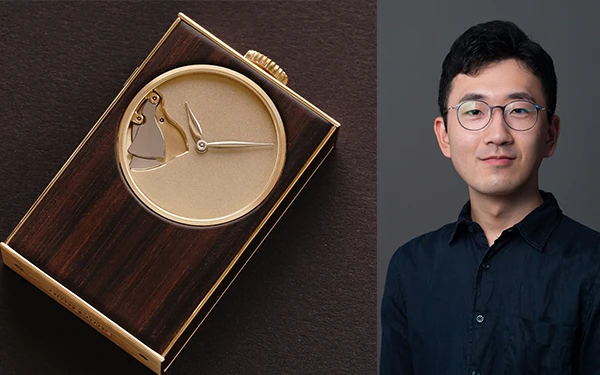
In 88, François-Paul Journe created a clock with the same function as Breguet's Sympatique, which automatically adjusts and winds the time when a pocket watch is set on a table clock. He commented with characteristic confidence about this work, saying, "Abraham-Louis Breguet first invented this type of clock, but my new version is technically more complex."
Moving to Switzerland

In 89, Journe decided he needed to leave France to further his craft, and so he founded a movement manufacturing company in Sainte-Croix, Switzerland, supplying the most discerning watch brands with superior movements.
It was during this period that the company produced its first wristwatch. It featured a tourbillon using a constant force device developed in 82, and this model served as the basis for the Tourbillon Souverain, released in 99. In 94, Journe received the Gaia Prize, considered the Nobel Prize of the watchmaking world, awarded by the International Watchmaking Museum in La Chaux-de-Fonds for exceptional achievement in watchmaking technology. This award was later awarded to famous watchmakers such as Michel Parmigiani, Philippe Dufour, and George Daniels, and Journe was finally recognized as one of Switzerland's leading watchmakers.

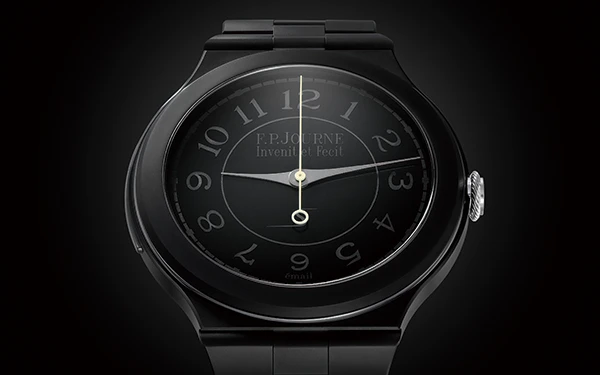
At the Basel Fair in the spring of 99, Journe finally broke through the barrier by exhibiting several chronometer watches signed "FP Journe - Invenit et Fecit." This inscription, which translates to "invented and made" in Latin, recalls the 18th-century French watchmakers working for the King who were allowed to use this appellation. The response was overwhelming, marking the launch of FP Journe as a brand. The Tourbillon Souverain marked the first milestone for FP Journe, using 18K gold for the movement, including the escapement.
A year later, he developed one of his signature creations, the Chronomètre Ésonance. It featured two gear trains, each with a barrel and balance wheel. The two balance wheels resonate without touching each other, creating a stable mutual influence and ensuring high precision. Both gear trains had subdials displaying the time, allowing for the display of a second time zone. Then, in 2001, FP Journe introduced the Octa, a watch with an automatic movement. Again, he was not satisfied with the ordinary: this movement offered a long power reserve of approximately 120 hours. Many more milestones would follow in the years to come.
FP Journe design

François-Paul Journe's starting point is the spirit of 18th- and 19th-century watchmakers, which he refines with his extensive knowledge and then transforms into modern timepieces using 21st-century technology. This has always garnered attention from watch enthusiasts. However, equally important are the distinctive designs of his watches, such as teardrop-shaped hands, screw-mounted subdials, and the "Invenit et Fecit" inscription. Since 2004, 18K gold has also been used for the movement bridges and mainplates, and all models except those in the Sport and Elegant collections are equipped with gold movements.
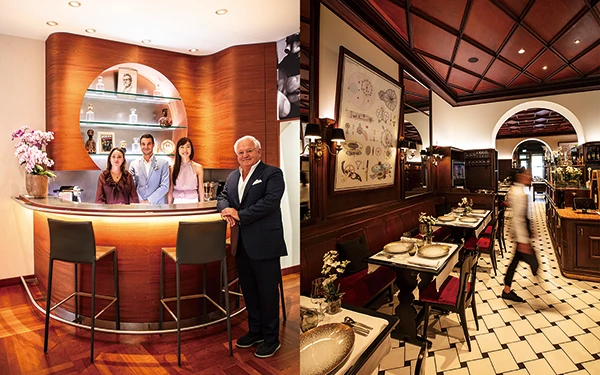
In 2000, Journe moved its workshop to an old industrial building in downtown Geneva, near the left bank of the Rhône River. It was purchased in 02 and remains the brand's headquarters to this day. Entering the building, the first thing you'll see is a large astronomical pendulum clock, crafted by French watchmaker Detouche in 1855. Through the door at the back, you enter the workshop where the watches are made. There are no large rooms here. Instead, you walk down a narrow corridor, and behind glass on either side, various ateliers are spread across several floors. FP Journe produces almost all of the components needed for watchmaking, from gears and screws to tenons, and the breadth of its manufacturing capabilities is impressive. This allows it to develop unique movements tailored to specific functions.

Furthermore, for the production of cases and dials, the company has its own factories, "Boitiers Genève" (case manufacturing) and "Cadraniers Genève" (dial manufacturing), located near Meyrin, a neighboring town in the canton of Geneva. Only balance springs, jewels, and sapphire crystals are purchased from external suppliers. Design and prototyping, manufacturing of movement parts on lathes and CNC milling machines, polishing, and decoration - all of these are done in-house, and assembly, adjustment, and decoration are carried out by the watchmakers in the workshop. Decorations such as Côtes de Genève and circular graining are done by machine in about 2% and 8% by hand. Of course, every watch, including each individual component, is constantly and meticulously inspected, not only by eye but also with cameras and other equipment.

Thanks to the large number of small rooms, each model has its own dedicated room, and every watch is made from A to Z by a single watchmaker. This method is usually only allowed at most watch brands for the creation of extremely complex complications. The watchmaker checks the watch he is assembling to see if a component needs to be made a little larger or smaller, or if a spring needs to be trimmed down a little to fit the hammers better. Then, precisely, it is reassembled once to check its operation, disassembled again, all parts are finished, and the watch is reassembled a second time. For complex watches like the Chronometer-Resonance, a final quality check can take several weeks.
Growth as a brand

This blend of industrial and artisanal elements is what sets the brand apart. To maintain its current status, François-Paul Journe has stated that he will not expand his brand any further. The annual production limit of 900 bottles is deliberate, and increasing the number would make it impossible to sustain this unique production system.
He has been a successful CEO of the company for many years. He has now sold 20% of his shares to Chanel. However, he remains a talented watchmaker. He works in the workshop almost every day and says he is still most comfortable at the watchmaking site. When creating prototypes, he personally wears the watches to check their operation and fine-tune them. The most complex watch in the collection, the Astronomic Souverain, was released in 2019. It combines 18 functions, including a tourbillon with a constant force device (remontoir d'égalité), a minute repeater, a moon phase, an equation of time, sunrise and sunset times, sidereal time, and a second time zone display. Its movement is made up of 758 components. At 950,000 Swiss francs, it is the brand's most expensive watch. A unique blue-dial model was sold at the Only Watch charity auction held that same year for 1.8 million Swiss francs.

However, François-Paul Journe's watchmaking ethos is at least as strong as ever, especially in the entry-level model, the Chronomètre Souverain (38,600 CHF). Featuring hours, minutes, small seconds, and a power reserve indicator, this model features two barrels, but their primary purpose is not to ensure a power reserve of approximately 50 hours, but rather to maximize torque stability. Perhaps this attention to detail and commitment to creating something great in a small watch are more characteristic of François-Paul Journe as a person and a brand like FP Journe than any elaborate complication. This is why he's so fond of the Chronomètre Souverain. He firmly believes that "it's easy to create something complicated, but difficult to create something simple."

http://www.webchronos.net/features/76482/

http://www.webchronos.net/features/87147/

http://www.webchronos.net/features/37640/