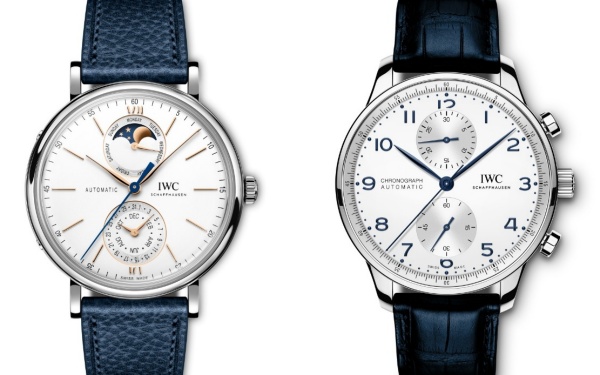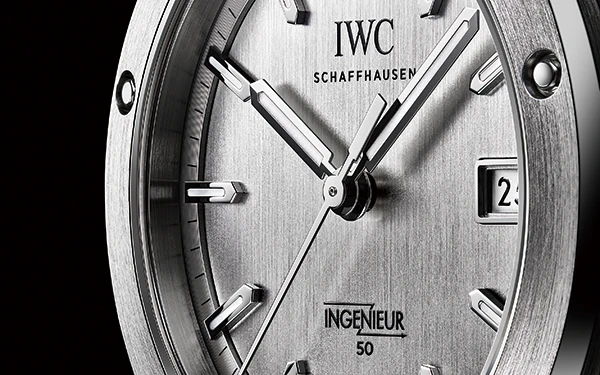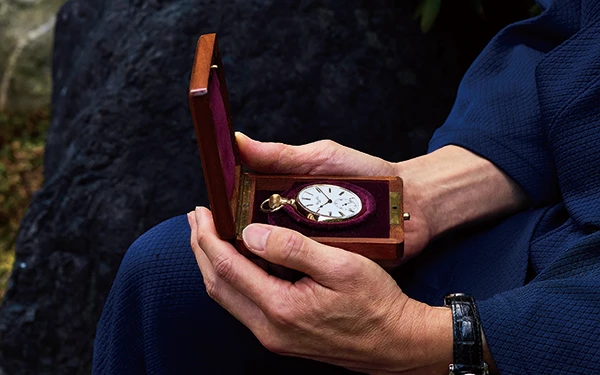
Thirty years have passed since the launch of IWC's Portofino. This collection, named after an Italian port town, was born purely by chance. Adapting a pocket watch movement for a wristwatch. We'd like to take a closer look at the history of the creation that began with this idea, its development, and the current state of the Portofino, which has become a success as the basis for thin complications.

Text by Masayuki Hirota (Chronos-Japan)
Edited by Hiroyuki Suzuki
[Article published in the July 2024 issue of Kronos Japan]
PORTOFINO REF.3513
A free-style look that shows the diversity of early Portofino

The first Portofino, Ref. 3513, was produced from the late 1980s to the early 90s. The model shown in the photo does not feature standard bar indexes, but rather a pilot's watch-style dial. Automatic movement (Cal. 37521 or Cal. 3752, based on the ETA2892A2). 21 jewels. Power reserve: approximately 42 hours. Water resistant to 30m. Reference product
According to IWC's official statement, the Portofino was introduced in 1984. At the time, IWC was restructuring its lineup under the direction of Günter Blümlein, focusing on iconic models. It's no surprise that he rejected the request to create a basic three-hand model. However, he was persuaded by the demand for a more conventional watch, and is said to have given the go-ahead for the collection that would later become known as the Portofino.


The Portofino was a success that defied Blümlein's expectations. The trigger was the addition of the Ref. 3513 in the late 1980s. The Portofino, which housed a highly tuned ETA2892A2 movement in a thin, bezel-less, two-piece case, was exactly what many consumers wanted. An IWC insider later confided to me, "The Jaeger-LeCoultre Master Control was a model inspired by the Portofino."

Following the success of the Portofino, IWC began experimenting with many new features. These included mechanical quartz movements, pointer dates, chronographs, perpetual calendars, and a variety of dial designs. The most eye-catching of these was the so-called "Mark dial" model. Despite being a slim dress watch, the dial design is nearly identical to that of the classic pilot's watch, the Mark 11. This was a rather unique attempt, but it could be said that the Portofino was such a hit that such "playful" designs were allowed. Contrary to the expectations of those involved, the Portofino has grown into a mainstay alongside Porsche Design and pilot's watches. So how did this basic model come about, and how did it grow into such a huge collection?


http://www.webchronos.net/features/72584/

http://www.webchronos.net/iconic/80402/

http://www.webchronos.net/features/84049/