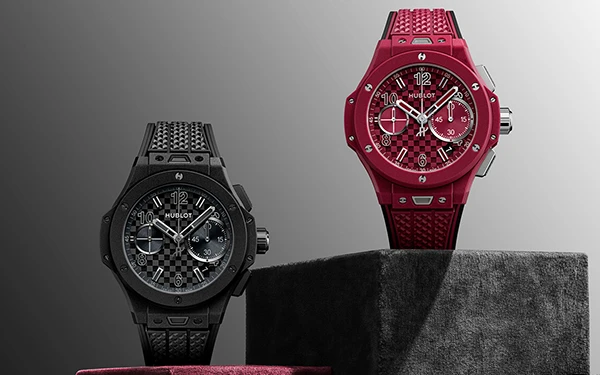
Since its launch in 2005, the Big Bang has continued its rapid advance. However, the reason it has gained such popularity is not just due to Hublot's outstanding marketing skills. The company has improved the Big Bang almost every year. Not only has it actively adopted new, proprietary materials, but it has also revamped the case shape and added in-house movements and complications to its lineup. We take a fresh look at the Big Bang, which has undergone major changes in the 10 years since its birth.

[Serial No. 31 / First published in the January 2016 issue of Chronos Japan]
BIG BANG FERRARI
The Prancing Horse, the pioneer of the "Unico-equipped Big Bang"

First released in 2015. The design and movement are the same as previous Ferrari models. However, the bezel has been changed to a unique carbon material mixed with titanium. The distortion-free case and precise interlocking of the parts make this a Hublot flagship. Automatic (Cal. HUB1241). 38 jewels. 28,800 vph. Power reserve approximately 72 hours. Carbon x Ti (45mm diameter). Water resistant to 10 bar. Limited to 1000 pieces worldwide. Price: 3,002,400 yen.
The partnership between Hublot and Ferrari began in November 2011. The first model, released the following year, featured an 18K Magic Gold and titanium case. The in-house Unico movement was chosen. The Big Bang Ferrari featured a revised case shape and size compared to the previous Big Bang.
Ten months prior to the meeting with Ferrari, then-CEO Jean-Claude Biver told Luxury Insider magazine:
"I am only interested in what is best for Hublot, and that means not steering the company in a direction that is not right for me for personal reasons. As you know, at Blancpain I did not initiate a partnership with F1 because it was not the right choice."
Hublot's involvement in motorsports, which began with its collaboration with F1, was completed with a partnership with Ferrari. However, in truth, it was Ferrari that Hublot wanted to partner with above all else. In 05, shortly after becoming CEO of Hublot, Biver met with Jean Todt, who was then CEO and head of racing at Ferrari. He reportedly brought a special Big Bang for Todt to collaborate with Ferrari. However, Todt ended up partnering with another company, so the model was later sold as the "Red Bang." This is another story from the eve of the birth of the Big Bang Ferrari.
Given this history, it is only natural that Hublot would put effort into Ferrari models. Biver emphasizes that "our relationship with Ferrari is a partnership, not a licensing agreement." The extraordinary level of perfection of this work shows that Ferrari models have always held a special place in his heart.