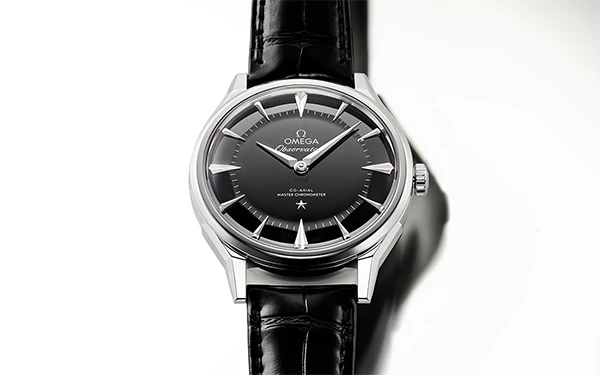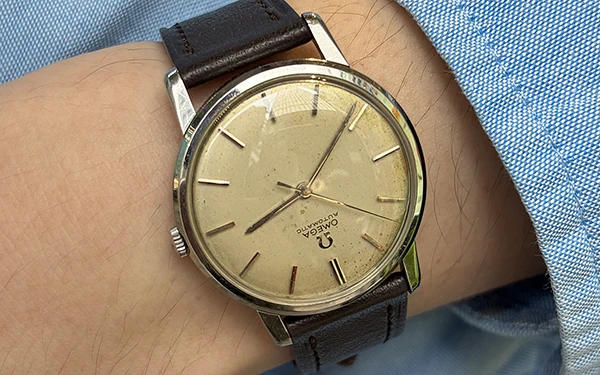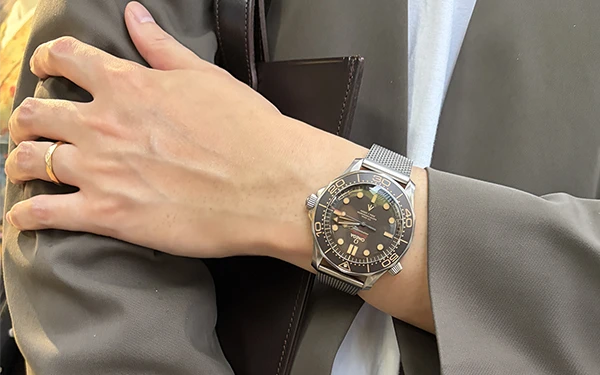

The Omega 1957 Trilogy thrilled watch enthusiasts at Baselworld 2017. It's no surprise, given its flawless reproduction, high-quality exterior, and outstanding performance as a practical watch. We'll focus on the Railmaster, a representative example of this trilogy, to explore Omega's origins and current maturity.

Masamasa Hirota (this magazine): Interview and writing
[Serialization No. 43 / First published in the July 2018 issue of Chronos Japan]
RAILMASTER [CK2914]
Antimagnetic railway clock

This anti-magnetic watch is resistant to magnetic fields of 1000 gauss. Its military watch base indicates its hand-wound movement. Hand-wound (Cal. 284). 17 jewels. 18,000 vph. Stainless steel (38mm diameter). Water resistant to 200 feet (approx. 60m). Price in 1957 was 275 Swiss francs. Reference product. Photo courtesy of Cares. Tel. 03-3635-7684
As electrical equipment became more widespread in the 1950s, the magnetic resistance of watches became a major issue. In response, Rolex released the Milgauss in 54, and IWC released the Ingenieur in 55. Omega followed suit with the Railmaster in 57, which was resistant to magnetic fields of 1000 gauss.
Although the name Railmaster means it was intended for railway workers, the prototype for this watch was originally a military watch (CK2777) for the Royal Air Force. The Royal Air Force asked Omega to develop a watch that would not be affected by the magnetic fields generated on board aircraft. The company sold the completed version (CK2777-1) in the Canadian market. In 55, Omega developed an improved version of this model, the CK2777-2, which became the prototype for the Railmaster. In other words, the Railmaster was a civilian version of a military watch. As proof of this, the Railmaster's movement was hand-wound to prevent the rotor from becoming dislodged.
So why "rail"? From the 1940s onwards, railroad companies in the US and Canada increasingly replaced steam locomotives with electric railcars. These were equipped with hybrid engines that generated electricity using a diesel engine and then used that electricity to power the motor. Quiet and fast, electric railcars revolutionized rail transport in the Americas, but they also caused train crew members' watches to become magnetized. Omega's strong focus on railroad workers is clear from its advertising at the time of its release. The background of the ad was the EMD E8 type (manufactured between 49 and 54), the latest electric railcar at the time.
The Railmaster was released with much fanfare, but the performance of the manually wound Railmaster fell short of its automatic rivals. Omega discontinued the Railmaster collection, and the name was shelved until 2003.


"OMEGA 1957 TRILOGY"
RAILMASTER MASTER CHRONOMETER
Limited edition reproduction with the latest specs

This model is a nearly faithful reproduction of the 1957 CK2914. It also features a Master Chronometer with magnetic resistance of over 15,000 gauss. Automatic (Cal. 8806). 35 jewels. 25,200 vph. Power reserve of approximately 55 hours. Stainless steel (diameter 38mm). Water resistant to 60m. Limited to 3557 pieces. Priced at 730,000 yen.
The Railmaster name was revived in 2003, but unfortunately, it did not feature ultra-magnetic resistance. It was not until 2017 that the Railmaster was truly resurrected. The modern Railmaster, based on the original, and its faithful replicas, are Master Chronometer compliant, with ultra-magnetic resistance of over 15,000 gauss. This magnetic resistance is actually 15 times that of the original. In addition, Omega gave the new Railmaster an extremely excellent exterior. We will discuss the so-called "modern version" later, but here we would like to focus on the excellent reproduction version.
To commemorate the 60th anniversary of the release of the Speedmaster, Seamaster 300, and Railmaster, Omega undertook to reissue these "trilogy" watches. However, since the original drawings no longer existed, Omega scanned the CK2914 case and created new drawings. Usually, even for reproductions, the case size differs from the original. However, Omega aimed to create a perfect reproduction, including the size.
This was made possible by efforts to improve the exterior, which began in 07. Omega, which began improving the texture of the case and dial with the De Ville Hour Vision, has applied that know-how to the Trilogy. One example is the domed sapphire crystal. Not only does it have the same curved surface as the original, but the nostalgic "Ω" mark is engraved in the center. The minute and second hands also have a strong curve, just like the 1957 model. The lacquered dial also has a blasted finish that is almost identical to the original. Compared to previous Omega models, the richness of the details is truly something else.
The new Railmaster combines ultra-magnetic resistance that exceeds the standards of practical watches with a desirable exterior. Omega's evolution has brought this reissue model to a stunning level of perfection.