
The men's 100m track and field race took place on the evening of August 4, 2024, Paris time. The race, which attracted worldwide attention, was a rare and fierce battle. Among them, Omega ambassador and American athlete Noah Lyles won the gold medal by a narrow margin. While it wasn't visible in the live video, the watch that ran alongside Noah Lyles in the 100m was the Speedmaster Dark Side of the Moon. The official ranking was determined by Omega's photo-finish camera, the Scan-O-Vision Ultimate.

What kind of watch did Noah Lyles, the gold medalist in the men's 100m, wear?
On the evening of August 4, 2024, Paris time, the men's 100m track and field race was held. After a fierce battle, American athlete Noah Lyles, an OMEGA ambassador, won the gold medal by a narrow margin. On his wrist was an OMEGA Speedmaster Dark Side of the Moon.
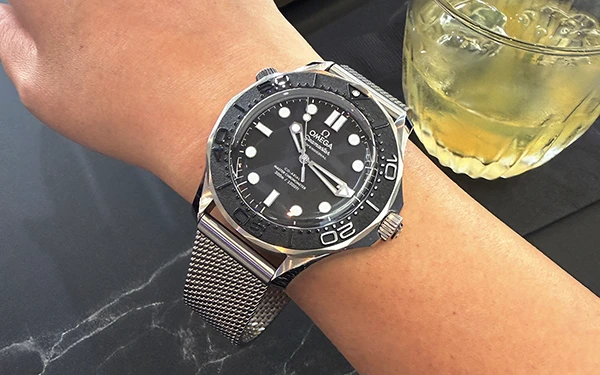
Noah Lyles' watch: Speedmaster Dark Side of the Moon Apollo 8

In December 1968, three astronauts on the Apollo 8 mission were the first to see the far side of the moon. The Dark Side of the Moon model pays tribute to that pioneering spirit. It features the in-house Cal. 1869 manual-winding movement, crafted in black with a laser-ablated finish to replicate the lunar surface. The model he wore was the original model released in 2018. At 44.25mm in diameter, 13.8mm thick, and weighing just 89g, this watch is by no means small. However, running in the Olympic 100m final didn't seem to affect Noah Lyles at all. Manual-winding (Cal. 1869). 44 jewels. 21,600 vph. Approximately 48-hour power reserve. Ceramic case (44.25mm diameter, 14mm thick). Water resistant to 50m. ¥165 million (tax included).

While the Caliber 1861 is still used in the flagship Speedmaster Professional Moonwatch model, the Caliber 1869, an openworked version of the Caliber 1861, is being used for the first time in the Apollo 8 model. The black version, featuring a distinctively textured moon relief, is striking. Previous models were equipped with the automatic Co-Axial chronometer-certified Caliber 9300, and the chronograph was a bi-compax movement.
Also pay attention to Omega's timekeeping technology!
As the athletes crossed the finish line, the scoreboard displayed the first place time of 9.79 seconds. The time was achieved by Noah Lyles and fellow Jamaican athlete Kishane Thompson. As everyone in the stadium watched the scoreboard with bated breath, the official result was announced: Lyles had won. This was because images from OMEGA's photo-finish camera proved that Lyles had crossed the finish line with a slight lead.

The latest photo-finish camera, "Scan-O-Vision Ultimate," introduced at this year's event, is capable of recording up to 40,000 digital images per second (compared to the 10,000 images recorded by conventional photo-finish cameras). Unlike high-speed cameras that capture a single moment of movement, this camera continuously records what happens at the finish line over a certain period of time, capturing many "time slices." These time slices are then instantly stitched together to create a composite photo showing the exact moment each athlete crossed the finish line, allowing the judges to quickly determine the results. This is exactly how the results of this year's race were determined.


http://www.webchronos.net/features/41534/2/

http://www.webchronos.net/news/70150/

http://www.webchronos.net/features/80081/

http://www.webchronos.net/news/119962/