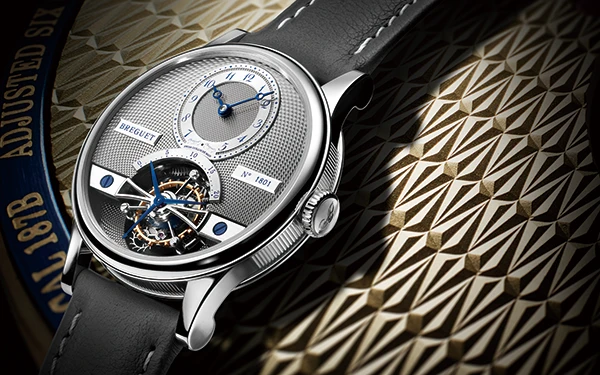

Breguet has announced the "Classic Perpetual Calendar 7327" as a new model for 2023. This new model, equipped with a perpetual calendar function, comes in two models: a white gold case and a rose gold case.

Breguet Classic Perpetual Calendar 7327

Automatic winding (cal. 502.3P). 21,600 vph. Power reserve approximately 45 hours. 18KWG case (diameter 39mm, thickness 9.13mm). Water resistant to 3 ATM. Price: 11,572,000 yen (tax included).
In the 1780s, Abraham-Louis Breguet achieved great success with his perpetual calendar watches, which automatically wound the mainspring by vibrating a rotor in response to the wearer's physical movements. These watches often featured calendar mechanisms, and it was around this time that Breguet first produced guilloched silver dials. In 2023, Breguet celebrated this historic model by adding two gold models to its Classique collection that offer a new interpretation of the perpetual calendar.
Breguet's new Classique Perpetual Calendar 7327 embodies the very essence of the brand: a watch that is both easy to use and extremely difficult to realize. A perpetual calendar, which accurately displays the calendar by taking into account the difference in the length of each month and leap years, is a fascinating watch mechanism.

Automatic winding (cal. 502.3P). 21,600 vph. Power reserve approximately 45 hours. 18KRG case (diameter 39mm, thickness 9.13mm). Water resistant to 3 ATM. Price: 11,572,000 yen (tax included).
To achieve this ingenious mechanism, the movement must incorporate a mechanical "memory" with a four-year cycle corresponding to 1461 days. Perpetual calendar mechanisms are generally based on a gear mechanism that controls the 24 hours and a large central lever that moves the entire mechanism each day. This means that a total of 294 parts are required to make this model work.
One of Breguet's primary goals was to offer a lightweight, comfortable watch. The movement chosen was the Caliber 502, which incorporates a calendar mechanism. At just 4.5mm thick, the Caliber 502.3.P is one of Breguet's thinnest movements, yet it is designed to deliver high performance despite its thinness. The open-top barrel contributes to the thinness while also providing stable power and a generous power reserve. The gold rotor is positioned off-center to maximize space on the movement's main plate and minimize its thickness.

The rhodium-plated automatic movement has a balance frequency of 3Hz and a power reserve of approximately 45 hours. The movement also uses silicon for the balance spring and the horn of the inverted straight-line escapement. This silicon material has many excellent properties, such as resistance to corrosion and wear, and is unaffected by magnetic fields, which contribute to the watch's precision.
The transparent caseback reveals the movement, showcasing Breguet's cherished decorative techniques: the hand-guilloched circular barleycorn pattern on the gold rotor, the Côtes de Genève pattern adorning the bridges, and the beveled and Côtes de Genève-like decoration on various other components. These exquisite decorations are executed by Breguet's Manufacture artisans in the heart of the Vallée de Joux.

The dial of this new Breguet model is as captivating as its movement. Its timeless design is expressed in a contemporary style, reflecting the brand's unique character. The dial is decorated with a Clous de Paris hobnail pattern, and the moon phase design, located between 1 and 2 o'clock, is designed to create a realistic look, with the moon motif finished by hand by hammering the surface.
The blue lacquer, reminiscent of the night sky, is mixed with sequins, subtly creating the appearance of starry skies depending on the angle of the watch. The day of the week, date, and four-year leap year cycle are all displayed in a balanced combination at the bottom of the dial. The 12 months are indicated by a retrograde hand that repeats along an arc from 10 to 12 o'clock. The hours and minutes are indicated by traditional Breguet hands in blued steel. The "Breguet" secret signature, created by the company's founder, is engraved between 11 and 12 o'clock, and between 12 and 1 o'clock.
The calendar display on the dial is adjusted by pressing a button embedded in the side of the 39mm case with a special pin. The day of the week is located at 4 o'clock, the moon phase between 4 and 5 o'clock, the date at 6 o'clock, and the 12-month and 4-year leap year cycle at 9 o'clock. The time is adjusted using the crown at 3 o'clock.


http://www.webchronos.net/news/58820/

http://www.webchronos.net/news/47869/

http://www.webchronos.net/features/38996/